1. Introduction: The Symphony of Flight
When you stand at a terminal window watching a massive commercial airliner taxi toward the runway, it is difficult not to feel a sense of wonder. How does a machine weighing hundreds of thousands of pounds—composed of millions of individual rivets, wires, and sheets of metal—transform into a graceful, soaring entity?
To the casual observer, an airplane might look like a single, solid object. In reality, it is a complex symphony of engineering, where distinct systems work in seamless unison. Understanding the “magic” of flight begins with breaking the aircraft down into its core architecture. Drawing from essential aerospace insights, we can distill the complexity of any fixed-wing aircraft into five fundamental pillars: the fuselage, the wings, the empennage, the landing gear, and the powerplant.
2. The Fuselage: Why Modern Planes are Like Stressed Soda Cans
The fuselage is the central body of the aircraft, acting as the spindle-shaped hub that houses the crew, passengers, and cargo. Historically, airplanes relied on a truss structure—a rigid framework of wood or metal tubing covered in fabric. While strong, these designs were not aerodynamically efficient.
Modern aerospace design has shifted toward “stressed skin” structures: Monocoque and Semi-Monocoque.
- Monocoque (French for “single shell”) designs use the outer skin to support almost all imposed loads.
- Semi-Monocoque designs, the most common today, use a substructure of bulkheads and longitudinal stringers to reinforce the skin, helping the aircraft manage bending stresses.
To understand the strength—and the fragility—of these designs, consider an aluminum beverage can. You can exert significant force on the ends of an upright, intact can without damage because the skin is “stressed” to provide integrity. However, because the skin itself is the primary structural member, it cannot tolerate dents. Even a tiny deformation on the surface causes the entire structure to lose its ability to carry a load, leading to a total collapse under pressure.
The Fuselage: The main body section of an aircraft. It holds crew, passengers, or cargo and serves to position the control and stabilization surfaces in specific relationships to the lifting surfaces.
3. The Wings: Busting the “Equal Transit Time” Myth
The wings are the primary airfoils of the plane, responsible for generating lift. However, the science behind them is often clouded by the “Equal Transit Time” myth—the idea that air molecules split at the front and must meet up at the back, forcing air over the curved top to move faster. In reality, the air has no “meeting time” or “appointment” at the back of the wing.
Lift is a more elegant combination of pressure and momentum. While Bernoulli’s principle describes the lower pressure created by faster-moving air, Newton’s Third Law (Action-Reaction) is equally vital. As the wing moves, it physically deflects air downward—a phenomenon known as “downwash.” Following the principle of F=ma, this downward acceleration of air mass results in a powerful upward reaction force: lift.
Beyond lift, wings are dynamic control centers:
- Ailerons: Located on the outer trailing edges, they control “roll” by moving in opposite directions.
- Flaps and Slats: These increase the wing’s surface area or camber during takeoff and landing to generate maximum lift and drag at lower speeds.
Airfoil: Any surface, such as a wing, propeller, or rudder, which provides aerodynamic force when it interacts with a moving stream of air.
4. The Empennage: The Airplane’s Hidden Steering Wheel
Often called the tail section, the empennage provides vital stability. It consists of:
- The Vertical Stabilizer (The Fin): Houses the Rudder, which controls “yaw” (left-to-right movement).
- The Horizontal Stabilizer: Usually houses the Elevator, which controls “pitch” (up-and-down movement).
In many modern designs, the traditional elevator is replaced by a Stabilator. This is a one-piece, all-moving horizontal tail that pivots from a central hinge point. Because the entire surface moves, it provides much greater control authority with significantly less physical strain on the pilot. To assist further, tiny movable surfaces called Trim Tabs (or antiservo tabs on stabilators) allow the pilot to “balance” the air pressure, maintaining a steady flight path without constant manual effort.
5. The Powerplant: More Than Just a Loud Engine
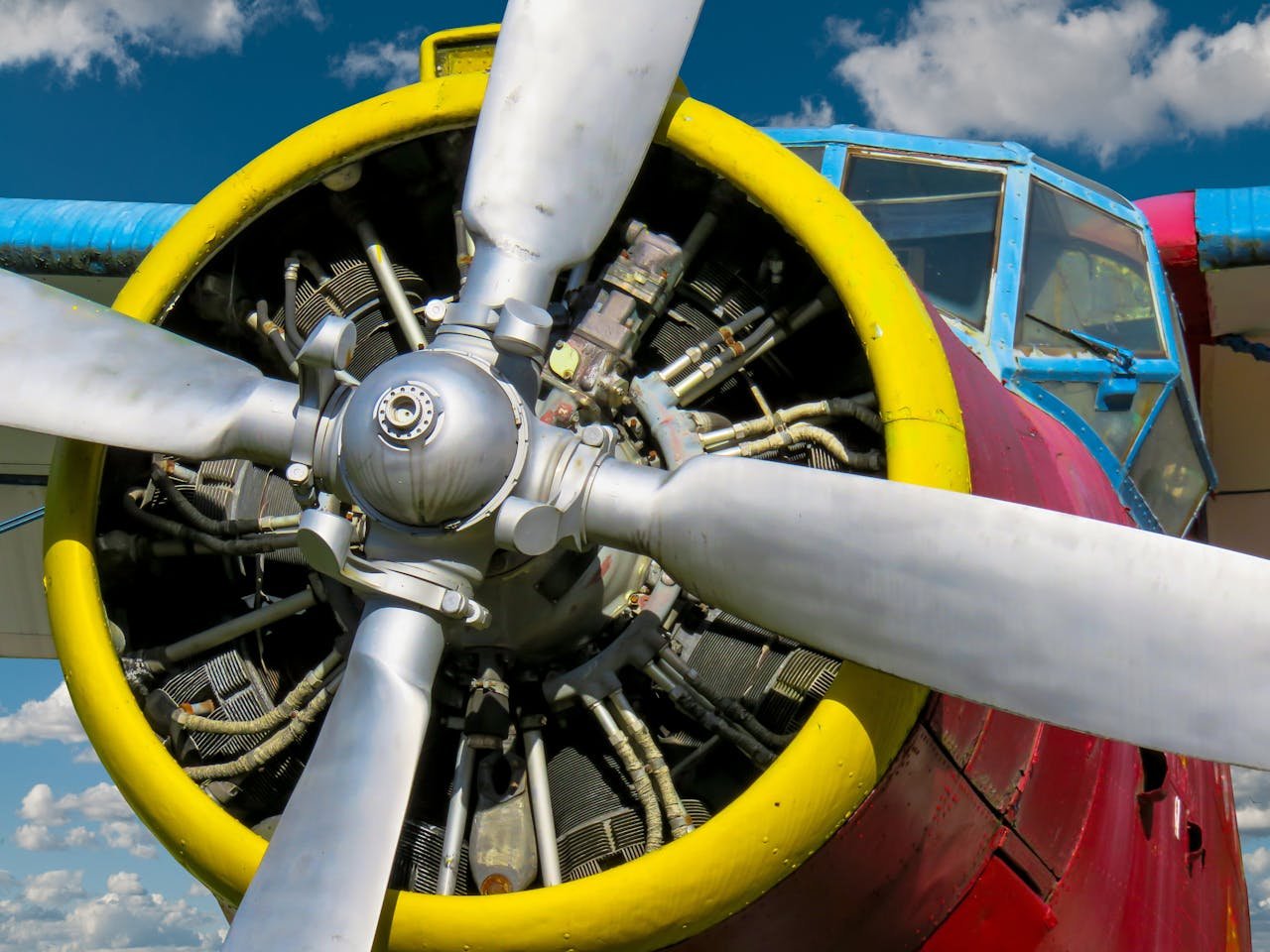
The powerplant is the heart of the aircraft, comprising the engine and the propeller. While its primary job is providing thrust, it acts as the aircraft’s main utility provider. It generates electrical power, creates a vacuum source for flight instruments, and provides cabin heat.
The housing for the engine is context-dependent:
- Cowling: A streamlined housing used for single-engine planes or nose-mounted engines.
- Nacelle: A streamlined enclosure used for wing-mounted engines on multi-engine aircraft, which often also houses the retracted landing gear.
The propeller itself is essentially a “twisted airfoil.” Just as a wing creates lift, the rotating propeller blades create forward-acting thrust, literally pulling the aircraft through the air.
6. Landing Gear: The Unsung Hero of the Tarmac
The landing gear supports the aircraft’s weight during the high-stress phases of ground operations. While wheels are standard, aircraft can be outfitted with floats for water or skis for snow.
Configuration varies by the “third wheel” location:
- Conventional (Tailwheel): Known affectionately as “Taildraggers,” these feature two main wheels forward and a small wheel under the tail.
- Tricycle Gear: Features a nosewheel and two main wheels further back, offering easier ground handling and visibility.
7. Reflection: The Future of Aerospace Materials
We are currently witnessing a shift from traditional aluminum to Composite Materials like carbon fiber. To understand why, we must look at a property called Isotropy.
Metals are isotropically uniform, meaning they have the same strength and physical properties in all directions. While reliable, this is inefficient. Composites, however, allow for directional engineering. By strategically positioning the fabric layers, engineers can make a part incredibly strong in the exact direction of the flight loads while keeping it lightweight elsewhere.
This synthesis of materials allows for “aha!” moments in design, like those seen in the Boeing 787. Its composite structure is so resistant to fatigue and stress that it can accommodate significantly higher cabin pressure and much larger windows, fundamentally changing the passenger experience.
8. Conclusion: A Final Thought on Complexity
The next time you settle into your seat and feel the floor vibrate as the engines roar to life, take a moment to consider the synergy occurring outside your window. The fuselage is holding the pressure, the wings are fighting gravity through action and reaction, and the empennage is keeping you on a steady path.
The next time you look out of a cabin window at the flexing wing, will you see a piece of metal, or a masterclass in aerodynamic tension?
——————————————————————————–
Resources Used
- 5 Main Aircraft Components, Proponent (2020)
- Anatomy of the Plane, Gopalan Colleges
- Aufbau des Flugzeuges, Jagdgeschwader 4
- Fuselage, Wikipedia
- Höhenruder (Elevators), Wikipedia
- Aerodynamic Lift Discussion, r/askscience (Reddit)
- Pilot’s Handbook of Aeronautical Knowledge, FAA (2016)
- Material Comparison Analysis, Tasuns Composite Technology Co., Ltd (2018)