The 2D Trap
When you settle into the driver’s seat of a car or take the helm of a boat, you are operating in a comfortably two-dimensional world. Your options are essentially left or right. But the moment an aircraft leaves the tarmac, the physics of navigation undergo a radical transformation. In the sky, you aren’t just steering; you are managing a complex, three-dimensional dance where a change in one direction inevitably ripples into the others. To master flight, a pilot must look past the physical cockpit and visualize three imaginary lines that govern every movement.
The “Invisible Pivot”: Everything Meets at the CG
To navigate the void, we imagine the aircraft threaded by three axes of flight. These aren’t just arbitrary lines; they are the geometric skeleton of aerodynamics. Crucially, all three axes intersect at a single, absolute point: the Center of Gravity (CG).
Think of the CG as the aircraft’s balance point. Because every movement is a rotation around this specific spot, its location dictates how the plane “feels” and reacts. If the CG is misplaced, the pivot shifts, and the entire physics of the flight deck changes.
Pitch: Balancing the Nose on the Lateral Axis
The Lateral Axis runs wingtip to wingtip, and rotation around it is called Pitch. This is the motion that sends your nose toward the clouds or down toward the horizon.
This movement is controlled by the elevator, located on the tail’s horizontal stabilizer. While it’s tempting to think the tail simply “lifts” the plane up, the reality is more nuanced. Aircraft wings naturally have a “nose-down” tendency. To counter this, the horizontal stabilizer is designed to create a constant downward force to keep the plane level.
The pilot manipulates this balance using the control stick:
- Pushing forward moves the elevator downward. This increases lift on the tail (reducing the downward force), which pitches the nose down.
- Pulling back moves the elevator upward. This decreases lift on the tail (increasing downward force), causing the nose to rise.
Roll: A Cardboard Box and the Wright Legacy
The Longitudinal Axis runs the length of the plane from nose to tail. Rotation here is called Roll, managed by the ailerons on the outer rear edges of the wings. By moving the stick side-to-side, a pilot “adds” lift to one wing and “subtracts” it from the other, causing the aircraft to tilt.
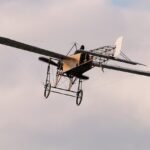
Modern ailerons are sleek, but the concept was born from a surprisingly humble moment of domestic insight. The Wright Brothers realized that to turn, they needed to do more than just point the nose; they needed to control the roll.
“The 1903 Wright Flyer didn’t have ailerons, so roll control was provided by a unique idea they called wing warping. Wilbur hit upon this idea while twisting a cardboard box from a bicycle inner tube as he chatted with a customer in the brothers’ shop. The tips of the wings were twisted (warped) like the box by a series of pulleys and cables.”
Yaw: The Secret Ingredient of a Coordinated Turn
The Vertical Axis passes straight up and down through the CG. Movement around this axis is known as Yaw. Controlled by the rudder on the vertical tail fin, this motion is managed not by the hands, but by the feet using floor pedals. Pressing the left pedal swivels the rudder left, pushing the tail right and swinging the nose to the left.
Yaw is often the hardest motion for students to visualize because it is rarely used alone. In a car, you turn the wheel and the car follows. In a plane, if you only use the ailerons to roll, the plane might “slip” or “skid.” To achieve a smooth, coordinated turn, a pilot must use the rudder in tandem with the ailerons. This ensures the aircraft’s nose stays aligned with its path as the lift vector shifts during the bank.
The Airplane’s Secret Desire: Returning to Equilibrium
An aircraft’s “personality” is defined by its stability—its ability to return to a desired flight path after a disturbance like a gust of wind. This is broken down into two phases:
- Static Stability: This is the initial tendency. Think of the “ball in a bowl”—if you push the ball, it immediately wants to roll back to the center. A stable airplane has this same “desire” to return to level flight.
- Dynamic Stability: This describes the motion over time. A plane might have positive static stability (it wants to go back) but poor dynamic stability, meaning it overshoots the center and oscillates wildly up and down before finally settling.
Designers balance these across all three types: Longitudinal (pitch), Lateral (roll/dihedral), and Directional (yaw).
The Gravity Trap: When Balance Goes Wrong
The position of the Center of Gravity is the “holy grail” of flight safety. If a pilot loads fuel or cargo incorrectly, they risk moving the CG outside the safe “envelope,” with drastic consequences:
- Forward CG (Nose-Heavy): The plane becomes “too stable.” While it may feel steady, it becomes sluggish and unresponsive. It requires more runway to take off, landing speeds increase, and the pilot must fight with constant back pressure on the controls.
- Aft CG (Tail-Heavy): This is the danger zone. As the CG moves backward, the plane becomes twitchy and unstable. Control responses become overly sensitive, and recovering from a stall or an unusual attitude can become physically impossible.
Even the Angle of Attack (AOA)—the angle at which the wing meets the oncoming air—plays a role. As the AOA increases, lift increases up to a point, but stability simultaneously decreases. The pilot must masterfully balance these aerodynamic factors; a plane that is too stable is a chore to fly, while one that is too unstable is a threat to its occupants.
Conclusion: The Art of the Invisible Dance
For an experienced pilot, managing the three axes eventually becomes as intuitive as breathing. But this “automatic” grace is built upon a foundation of rigid physics and historical genius. The next time you feel that gentle bank into a turn or the lift of the nose on takeoff, remember that the pilot isn’t just moving a stick—they are masterfully balancing an invisible dance between gravity, lift, and three imaginary lines. Is the pilot merely steering, or are they conducting a symphony of forces that began with a twisted cardboard box in a bicycle shop?