It’s a modern marvel we often take for granted: a million-pound metal tube, filled with people and cargo, lifting effortlessly into the sky and soaring across continents. We know it works, but how? We’ve all heard simplified explanations involving curved wings and airflow, but many of these popular theories are either fundamentally incomplete or outright incorrect.
The physics of flight is far more fascinating and counter-intuitive than most people realize. While the basic principles were harnessed by the Wright brothers in 1903, the science behind them is a complex interplay of pressure, momentum, and energy. To separate fact from fiction, we’re diving into the principles explained by aeronautics experts at NASA and other aviation authorities.
This article will explore five of the most surprising truths about aerodynamics. From the real reason wings generate lift to the strange relationship between speed and drag, these concepts challenge common assumptions and reveal the elegant physics that keep aircraft aloft.
1. The Common Explanation for Lift Is Wrong (or at Least, Incomplete)
You’ve likely heard the “longer path” or “equal transit time” theory: a wing is curved on top, so the air traveling over it has a longer distance to go and must speed up to “meet” the air from the bottom at the trailing edge. This faster air creates lower pressure, and thus, lift. It’s a simple, intuitive idea, but it’s wrong. In reality, the air flowing over the top of a wing moves much, much faster than this theory would suggest, and there is no physical law requiring the particles to meet simultaneously.
The scientific community has often presented two main explanations for lift, one based on Daniel Bernoulli’s work and the other on Isaac Newton’s laws. The “Bernoulli” position focuses on the pressure difference: the curved airfoil forces air to accelerate over the top, leading to lower pressure above the wing compared to the higher pressure below it, creating an upward force. The “Newton” position explains lift as a reaction force: the wing is angled to deflect a mass of air downwards (the action), which results in an equal and opposite upward force on the wing (the reaction).
For years, proponents debated which theory was correct. But as NASA explains, this is a false dichotomy. Both are correct and complementary, describing the same phenomenon from different perspectives. The ‘Newtonian’ view focuses on the net momentum change as the wing forces air down, while the ‘Bernoulli’ view focuses on the integrated pressure field around the airfoil. They are two sides of the same coin, and both are required for a complete picture.
So both “Bernoulli” and “Newton” are correct. Integrating the effects of either the pressure or the velocity determines the aerodynamic force on an object.
2. Slowing Down Can Actually Increase Drag
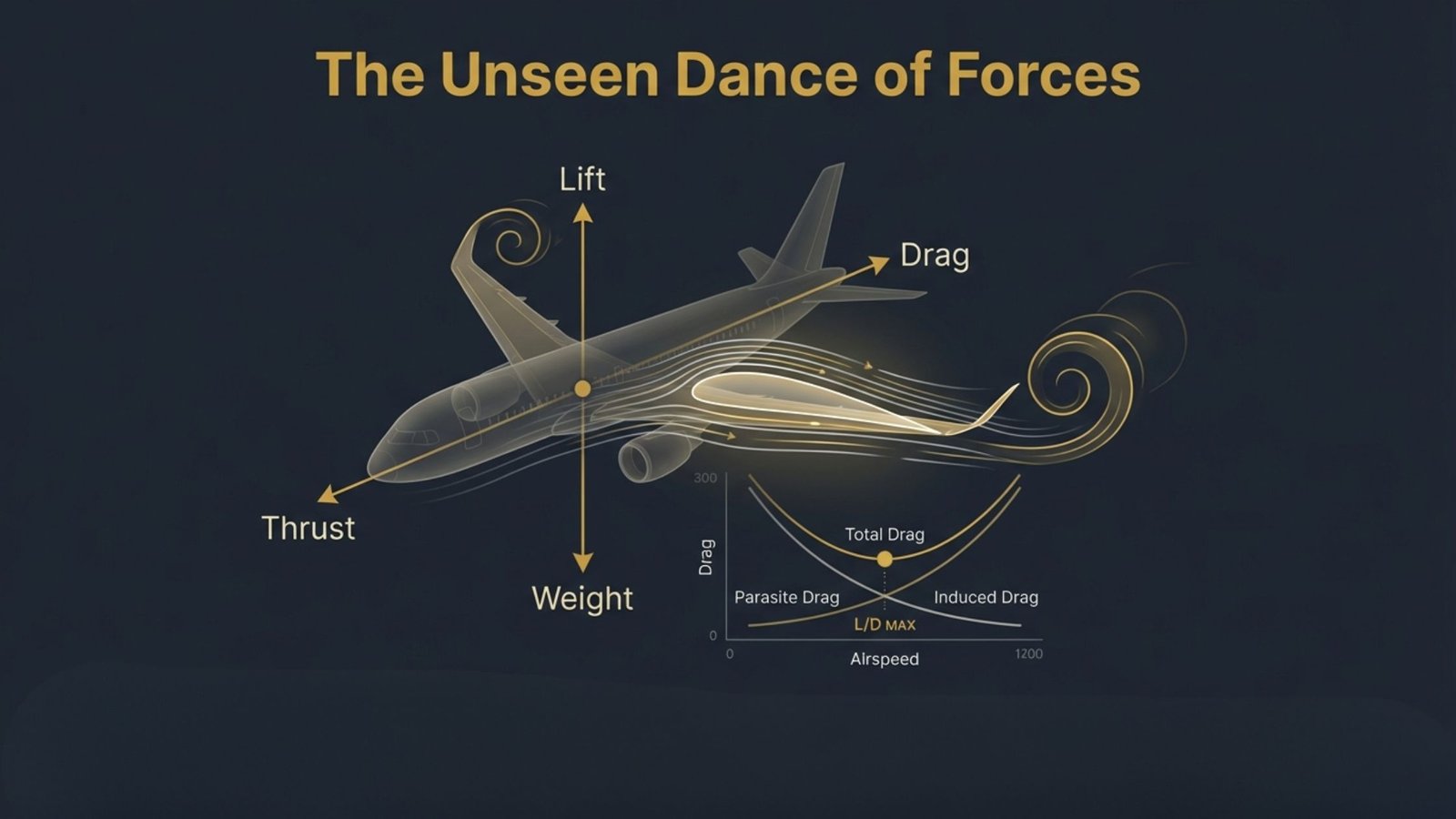
Drag is the aerodynamic force that resists an aircraft’s forward motion. Intuitively, we assume that the faster you go, the more drag you create. While this is true for one type of drag, it’s completely backward for another. Drag comes in two primary forms: parasite drag and induced drag.
Parasite drag is the intuitive kind. It’s caused by the aircraft’s shape (form drag), the friction of air moving over its surfaces (skin friction), and the interference of airflow where components like wings and fuselage meet. Just like sticking your hand out of a moving car window, parasite drag increases as the square of the airspeed.
Induced drag, however, is the counter-intuitive component. It is an unavoidable byproduct of producing lift. It is created by wingtip vortices, which are powerful whirlwinds of air that form as the high-pressure air under the wing tries to flow around the wingtip to the low-pressure area on top. This airflow creates a downward push of air, or downwash, which tilts the total lift force slightly backward, creating a resistance component. The surprising relationship is that induced drag increases as airspeed decreases. This is because to maintain lift at lower speeds, a pilot must increase the wing’s angle of attack, which in turn creates stronger, more energetic vortices and therefore more induced drag.
The slower the airplane, the more the induced drag, especially as it nears the stalling speed.
3. A Plane Stalls Because of Its Angle, Not Its Speed
The term “stall” often conjures a dramatic image of an engine quitting and an aircraft falling from the sky. This is a common and dangerous misconception. An aerodynamic stall has nothing to do with the engine and is not directly caused by flying too slowly.
A stall is a purely aerodynamic event that occurs when the wing exceeds its “critical angle of attack” (AOA). The AOA is the angle between the wing’s chord line (an imaginary line from its leading to trailing edge) and the oncoming air. As this angle increases, lift increases—but only up to a point. Once the critical AOA is exceeded, the smooth airflow over the top surface of the wing separates and becomes turbulent, causing a sudden and dramatic loss of lift.
A crucial principle of aerodynamics is that a given wing always stalls at the same critical AOA, which is determined by its design (typically between 16 and 20 degrees). While stalls are most common at low airspeeds—like during takeoff or landing, where a higher AOA is needed to generate sufficient lift—they can occur at any airspeed. This is the same reason induced drag is so high at low speeds—that increased angle of attack, while necessary for lift, creates stronger wingtip vortices and brings the wing closer to its critical stall angle. A pilot can induce a high-speed stall by performing an aggressive maneuver, such as a steep turn or a rapid pull-up from a dive, which increases the load factor on the aircraft and forces the wing to exceed its critical AOA even while traveling very fast.
The angle of attack at which an airplane stalls remains constant regardless of gross weight.
4. The Engine’s Job Isn’t to Lift the Plane
It seems logical to assume that an aircraft’s powerful engines are what lift it into the air. This is a fundamental misunderstanding of the four forces of flight. In steady, unaccelerated, level flight, the forces are in balance: Lift opposes Weight, and Thrust opposes Drag.
The engines’ one and only job is to produce thrust—the forward force required to overcome the rearward pull of drag. It is the wings, through their aerodynamic interaction with the air, that generate the lift needed to counteract the aircraft’s weight. The engines simply provide the forward motion necessary for the wings to move through the air and do their job.
The most powerful illustration of this principle is the glider. Gliders have no engines and therefore produce zero thrust, yet they fly perfectly well. They are towed to altitude or launched and then use their highly efficient wings to generate lift as they glide, subtly converting the force of their own weight into the forward motion needed to sustain flight. This proves that lift is a function of the wings and airflow, not engine power.
Note that the job of the engine is just to overcome the drag of the airplane, not to lift the airplane… In fact, there are some aircraft, called gliders that have no engines at all, but fly just fine.
5. A Propeller Is a Twisted, Spinning Wing
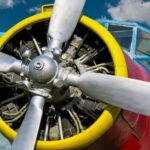
A propeller isn’t just a simple fan blade pushing air backward. It’s a sophisticated aerodynamic device—essentially a set of rotating airfoils, shaped much like an airplane’s wings, but oriented vertically.
Just like a wing generates lift, a spinning propeller blade generates thrust by creating a pressure differential. As it rotates, its airfoil shape accelerates air, creating a low-pressure area in front of it and a high-pressure area behind it. This difference in pressure produces a forward-acting force that pulls the aircraft through the air.
The most ingenious design feature of a propeller is its “twist.” If you look closely at a propeller, you’ll see that the blade angle is not uniform from the hub to the tip. This is because, in one rotation, the tip of the blade travels a much greater distance—and therefore moves much faster—than the root of the blade near the center. To ensure the propeller works efficiently, the twist is engineered to maintain a relatively consistent angle of attack along the entire length of the blade. The blade angle is greatest at the slow-moving root and smallest at the fast-moving tip, which equalizes the thrust generated and prevents parts of the blade from stalling.
By “twisting” the blade, you get a relatively uniform angle of attack across the entire propeller blade.
Conclusion
The physics that allows a massive aircraft to navigate the skies is a testament to human ingenuity, but it’s also more nuanced than many of the simplified explanations we’ve come to accept. From the dual nature of lift to the counter-intuitive behavior of drag, the forces governing flight are a constant balancing act. A stall is about angles, not speed; an engine produces thrust, not lift; and a propeller is far more than just a fan.
These principles show that aerodynamics is a field of elegant and sometimes surprising truths. The next time you look up at an aircraft gliding across the sky, what hidden forces and surprising principles will you see at play?
Resources
- “3 Types of Drag Affecting Flight” – Spartan College of Aeronautics and Technology
- “Aerodynamics of Flight – Five Mile Final | PHAK”
- “Airplane Cruise – Balanced Forces” – Glenn Research Center | NASA
- “Bernoulli and Newton” – Glenn Research Center | NASA
- “Bernoulli’s Principle” – NASA
- “Forces in a Climb” – Glenn Research Center – NASA
- “Forces on an Airplane” – Glenn Research Center | NASA
- “Four Forces on an Airplane” – Glenn Research Center – NASA
- “General Thrust Equation” – Glenn Research Center | NASA
- “How A Propeller Generates Thrust” – Boldmethod
- “The Analytical Framework of Aerodynamic Forces…”
- “The Role of Newton’s Third Law in Aviation” – Pilot Institute
- “Thrust” – Glenn Research Center – NASA
- “Understanding the Aerodynamic Forces in Flight (lift, drag…)” – Study flight
- “What Is Aerodynamics? (Grades K-4)” – NASA
- “Wings and lift” – Science Learning Hub