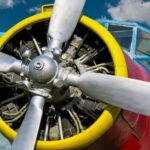
Imagine you’re cruising at 3,000 feet. The steady, reassuring thrum of the engine is the heartbeat of your flight. Then, without warning, the heartbeat stops. The vibration ceases, replaced by a surreal, high-pitched whistling of wind against the airframe. The propeller slows from a blur to a visible, rhythmic “windmilling” as the relative wind tries to keep it turning.
To a passenger, this is the beginning of a crisis. To a trained pilot, it’s a transition to a different kind of physics. You haven’t lost the ability to fly; you’ve simply changed your source of power. Gravity is now your engine, and your altitude is your fuel. To spend that fuel wisely, you must immediately find the “sweet spot” of flight: Best Glide Speed (V_G).
The U-Curve: Where Physics Finds a Compromise
In the cockpit, V_G is often a single number etched into a pilot’s memory—65 knots for a Cessna 172, or perhaps 105 knots for a Beechcraft Bonanza. But aerodynamically, it represents a profound equilibrium known as L/D Max, or the point of maximum lift-over-drag.
Every aircraft is subject to two competing types of drag that create a “U-shaped” curve of resistance:
- Parasite Drag: This is the friction of the air against the “skin” of the plane. It increases exponentially as you fly faster.
- Induced Drag: This is the byproduct of creating lift. It is strongest at low speeds when the wing is at a high angle to the wind.
The point where these two curves intersect is the bottom of the “U”—the point of minimized total drag. As noted by the experts at Air Traffic Insider, this speed “is not just a random number; it is determined by the point where total drag is minimized.” Flying faster than V_G wastes altitude fighting parasite drag; flying slower wastes it fighting induced drag. V_G is the only speed that allows you to cover the maximum horizontal distance for every foot of altitude surrendered.
The Heavyweight Advantage: 747 vs. Cessna
It is a common myth that small, light planes are the world’s best gliders. In reality, the “heavy metal” of commercial aviation often leaves trainers in the dust. This efficiency is measured by the glide ratio.
A Cessna 172 has a glide ratio of approximately 9:1. This means for every 1,000 feet of altitude lost, you can travel 9,000 feet (about 1.5 nautical miles) forward in zero-wind conditions. Contrast this with a Boeing 747, which boasts a glide ratio of roughly 15:1.
Why the massive gap? It comes down to design. The 747 features a high aspect ratio (long, narrow wings) and a highly refined aerodynamic profile that drastically reduces parasite drag relative to its size. While the 747 will reach the ground much faster than a Cessna, it will travel nearly twice as far over the ground during its descent.
The Weight Paradox: AOA and the Proxy of Speed
One of the most nuanced lessons a flight instructor teaches is the relationship between weight and gliding. A common “aha!” moment occurs when a pilot realizes that a heavy plane and a light plane of the same model have the exact same glide ratio. They will both land in the same spot, but the heavy plane will get there sooner.
Technically, Best Glide is not a speed, but a specific Angle of Attack (AOA)—the angle at which the wing meets the oncoming air. Because most general aviation aircraft lack AOA indicators, we use airspeed as a “proxy.”
If your aircraft is significantly below its maximum gross weight, you must fly slower to maintain that ideal AOA. If you are heavy, you must fly faster. For high-performance aircraft, this math matters.
As aviation expert Scott Perdue points out, calculating this in the heat of an emergency is often a “dubious use of time” unless the weight difference is greater than 10–15%. For a Bonanza, this could mean the difference between 105 knots at gross weight and 97 knots when light. In a crisis, unless you have a reference table, it’s usually better to fly the book number and focus on the landing.
No Second Chances: The Space Shuttle’s 10x Descent
The ultimate testament to the physics of gliding is the Space Shuttle. Upon re-entry, the Shuttle became a high-tech glider with no engines and “no go-arounds.”
The stakes were astronomical. While a Cessna 172 drifts down at a gentle 600 to 700 feet per minute (fpm), the Shuttle plummeted at a staggering 4,000 to 6,000 fpm. That is roughly 10 times faster than a light aircraft. Yet, by meticulously managing its energy and maintaining its version of V_G, the Shuttle proved that the same laws of aerodynamics keeping a trainer aloft can bring a spacecraft home from orbit with pinpoint precision.
Survival is as Simple as ABC
When the engine fails, the pilot’s workload spikes. To stay calm and methodical, we use the ABCs of emergency management:
- A – Airspeed: This is the immediate priority. You must pitch the aircraft to establish V_G. Speed is controlled by the elevator in a glide. As Steve from The Wired Flyer explains, we use the airplane’s weight to our advantage: “Gravity’s pulling us down maintaining that air flow over the wings so that we can continue to produce lift.”
- B – Best Field: Locate a landing spot within your glide range.
- C – Checks & Communication: Attempt a restart and, if time permits, alert Air Traffic Control.
Distance vs. Time: Knowing When to Switch
A master pilot understands that V_G is for distance, but sometimes you need time.
If you are directly over a suitable field and have altitude to spare, you might transition to Minimum Sink Speed. This speed is slightly slower than Best Glide and results in the lowest possible descent rate. While V_G helps you reach the field, Minimum Sink gives you the most time to run checklists, deploy flaps, and prepare for touchdown.
To judge if you can reach a distant field, use the Sightline Technique: Look through the wingtip at your target.
- If the field appears to be moving up in the windshield or your field of vision, you are falling short and will likely end up in the “drink.”
- If the field stays stationary or moves down toward the nose, you are overshooting or “making” the field.
Remember: these ratios assume zero wind. If you are facing a headwind, it will “eat” your glide. In that case, you must fly slightly faster than the published V_G to penetrate the wind and maximize your progress over the ground.
Conclusion: The Physics of Peace of Mind
The Best Glide Speed isn’t just a technical specification; it is a pilot’s primary survival tool. It represents the point where the invisible forces of drag reach a truce with the pull of gravity.
By understanding the “math of the air,” a pilot transforms a terrifying mechanical failure into a manageable scientific problem. The silence of a failed engine isn’t the end of the flight—it’s the moment the pilot becomes a true practitioner of aerodynamics. As long as you maintain that “sweet spot” of airspeed and pitch, you aren’t falling; you are merely choosing where to land.