
1. Introduction: The Invisible Weight of the Sky
Have you ever rolled into a steep turn and felt an invisible hand suddenly press you deep into your seat? Or perhaps you’ve felt that stomach-churning lightness at the top of a roller coaster hill. In the cockpit, we call this “loading up the wings,” but what you’re actually feeling is the dynamic nature of weight.
To a physicist, weight isn’t a static number on a scale; it’s a variable. In aviation, we manage this through Load Factor—the ratio of the total lift the wings are producing to the actual weight of the aircraft. Measured in G-forces, 1G represents the steady pull of gravity we feel standing on the ramp. But the moment you move the yoke, that 1G baseline is out the window.
2. The 60-Degree Double: How Turns “Grow” Your Aircraft
When you’re flying straight and level, your wings produce just enough vertical lift to cancel out gravity. But as soon as you bank, that lift vector tilts. Newton’s First Law tells us that your airplane wants to keep moving in a straight line; this inertia (or centrifugal force) resists the turn, pulling the aircraft “outward.”
To maintain altitude while banked, you have to pull back on the yoke to increase your angle of attack. This creates more total lift to ensure the vertical component still supports the airplane’s weight. However, this extra “back pressure” is exactly what increases the load on the wings.
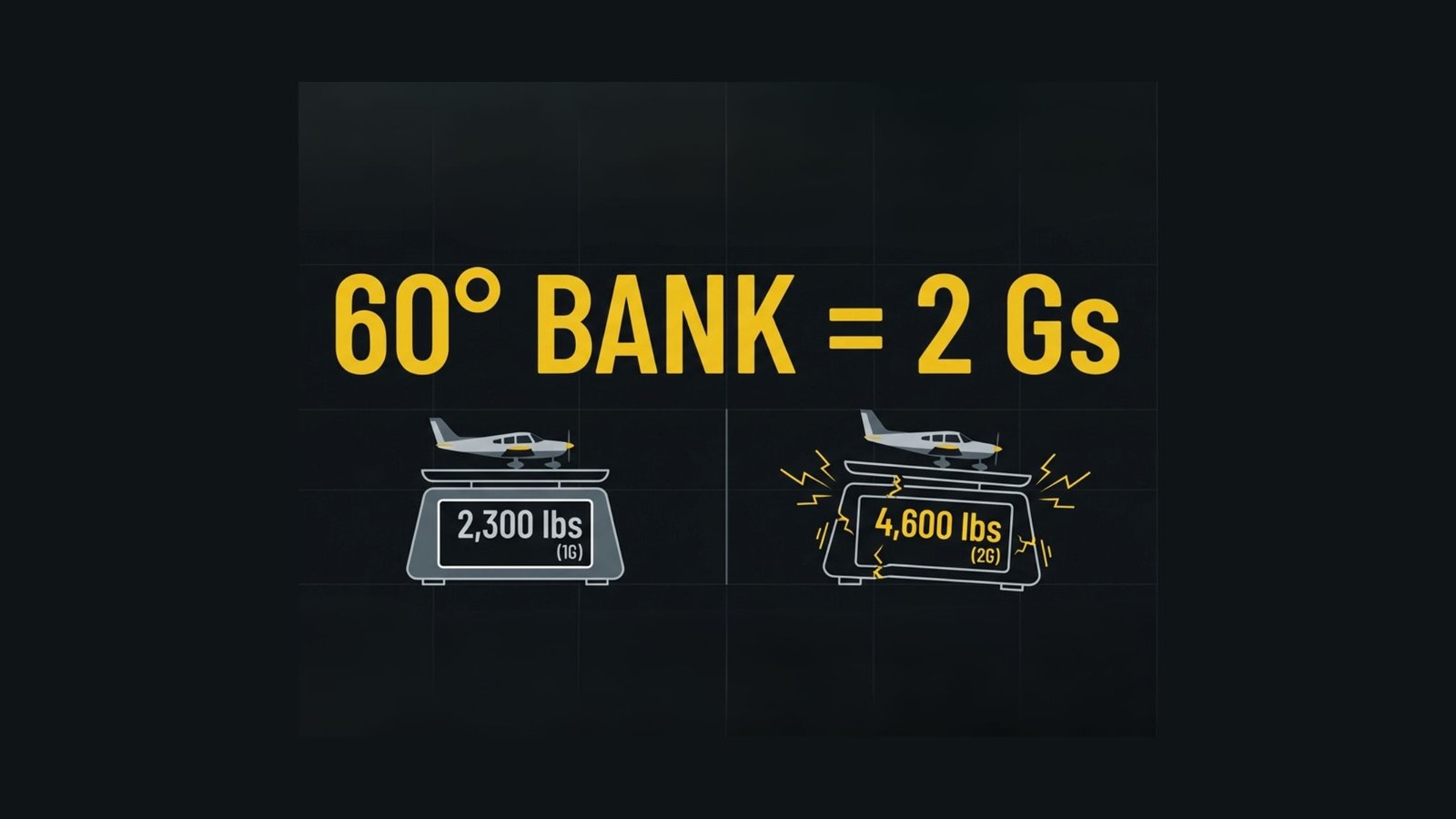
At a 60-degree bank, the geometry of this lift-split follows a precise trigonometric rule: 1 / \cos(\text{bank angle}). Since the cosine of 60 is 0.5, the math is simple: 1 / 0.5 = 2.
“At a 60° bank angle, the airplane and everything inside experience 2G, meaning everything feels twice as heavy.”
In this state, a 200-pound pilot effectively weighs 400 pounds. You feel heavy because you are heavy—the wings are now supporting twice the aircraft’s mass just to keep you from descending.
3. The Accelerated Stall: The Speed Trap You Didn’t See Coming
Here’s the part that catches most pilots off guard: your stall speed is not a fixed number. Because a stall occurs when the wing exceeds its critical angle of attack, and because you must increase that angle to support a higher load factor, your stall speed climbs as G-loads increase. We call this an accelerated stall.
The math follows the square root of the load factor. If you are pulling 2Gs in that 60-degree turn, the square root of 2 is approximately 1.41. This means your stall speed increases by 41%.
For a Cessna 152 with a normal 1G stall speed of 48 knots, a 60-degree bank suddenly pushes that stall speed up to 68 knots.
If you’re cruising at 60 knots—well above the “white arc”—and you suddenly bank into a steep turn to avoid an obstacle, you’ll stall the airplane instantly despite the fact that your airspeed hasn’t changed.
4. The “Paperclip” Effect: Why G-Limits Matter
Your Pilot’s Operating Handbook (POH) lists G-limits for a reason. While wings rarely snap off like a dry twig, exceeding these limits causes “bent metal”—permanent structural deformation. Think of the paperclip analogy: you can bend a paperclip once and it seems fine, but if you repeatedly stress it back and forth, the metal becomes brittle and eventually snaps. An airframe that has been repeatedly “over-G’d” suffers from metal fatigue, weakening the structure over time.
Consider the sheer forces involved: in a Cessna 172 rated for a 3.8G limit, the wings might be asked to support over 9,200 pounds of force during a heavy maneuver.
Pro-Tip: Your aircraft is structurally stronger with the flaps up. Most POHs show that structural load limits are significantly reduced when flaps are extended, as they change how the load is distributed across the wing spar.
It’s also worth noting that airplanes are far weaker against negative Gs (the “blood to the head” sensation). While a Cessna 172 can handle +3.8G, it is only rated for -1.52G.
5. Maneuvering Speed (VA): Your Aerodynamic Safety Valve
To keep from bending the metal, engineers gave us Maneuvering Speed (VA). Think of this as a “magical” safety valve. At or below this speed, the airplane will reach its critical angle of attack and stall before the wings can generate enough lift to cause structural damage. Essentially, the airplane “gives up” and stalls to protect itself.
However, V_A changes with weight, and this is often counter-intuitive. A lighter airplane actually has a lower maneuvering speed. Why? Because a lighter airplane is more “accelerable.”
Think of it this way: if a 160-pound person and a 500-pound person both hit the ground at 2Gs, the heavier person generates significantly more force (1,000 lbs) than the lighter one (320 lbs). Because a lighter airplane is lighter, a gust or control input will “flick” it to a higher G-load much faster than it would a heavy airplane. To stay safe, the lighter airplane must fly slower so it stalls before those G-forces can reach the structural danger zone.
6. Conclusion: The Physics of Pilot Proficiency
Load factor is more than just a number on a chart; it is the physical manifestation of the trade-off between maneuverability and safety. Every time you bank the wings or pull out of a descent, you are actively changing the weight of your aircraft and the speed at which it will stop flying.
Managing load factor isn’t just about passenger comfort—it’s about structural preservation and stall awareness. The next time you roll into a steep turn, pay attention to the “heavy” feeling in your seat and ask yourself: Do I know exactly what my stall speed is right now?