Why Fighter Jets Are Designed to Be Unstable (and 4 Other Secrets of Flight)
Introduction: The Hidden Hand Guiding the Plane
If you’ve ever been a passenger on a commercial flight, you’ve likely felt the aircraft dip and sway through turbulence, only to settle back into a smooth, steady path. It’s easy to marvel at how a machine weighing hundreds of thousands of pounds can fly with such predictability and grace. This isn’t magic; it’s the result of an invisible but brilliantly engineered system known as “stability.”
Stability is an aircraft’s inherent ability to correct for disturbances and return to its original flight path. It’s the hidden hand that constantly guides the plane, making it easier for pilots to control and ensuring a safe journey. But the principles that create this stability are often deeply counter-intuitive.
This article will reveal five of the most surprising truths behind how airplanes are designed with an inherent tendency to return to stable flight, from wings that push down to the intentional instability of the world’s most advanced jets.
——————————————————————————–
1. The Secret to Stability? Airplanes Are Built to Be Intentionally Nose-Heavy.
The foundation of an aircraft’s stability in flight, known as longitudinal stability, begins with a fundamental and seemingly backward principle: designers place the aircraft’s Center of Gravity (CG) slightly ahead of its Center of Lift. The Center of Gravity is the point where the aircraft’s total weight is concentrated, while the Center of Lift is the point where the lifting force from the wings is focused.
At first glance, this seems like a flawed design. Placing the weight ahead of the lift should create a constant tendency for the aircraft to nosedive. It seems that a pilot would have to constantly fight to keep the nose up.
However, this nose-down tendency is not a flaw; it’s the crucial first step in a delicate balance of opposing forces. By designing the aircraft to want to do something predictable—in this case, pitch down—engineers can then introduce another force to perfectly counteract it. This creates longitudinal stability—the aircraft’s stability around its lateral, or wingtip-to-wingtip, axis, which controls the pitch.
——————————————————————————–
2. That Little Wing on the Tail Actually Pushes Down.
To counteract the nose-heavy design, the horizontal stabilizer on the tail is engineered to produce a downward force, not lift. This tail-down force balances the nose-down tendency created by the CG placement, creating a stable equilibrium that allows the aircraft to maintain a level flight attitude.
A simple way to think about it is that the horizontal stabilizer functions as an upside-down wing, pushing the tail down to keep the nose up.
“i like to tell students that it’s basically an upside down wing back here”
This choreographed response is what allows a properly trimmed aircraft to essentially maintain its speed. If the plane speeds up, the increased airflow over the horizontal stabilizer creates more downforce, which automatically raises the nose, slowing the plane back to its trimmed speed. If it slows down, the tail-down force lessens, the nose drops, and the plane accelerates back to equilibrium.
——————————————————————————–
3. The Paradox: The Most Maneuverable Fighter Jets Are Designed to Be Unstable.
Stability makes an aircraft easier to control, but it also makes it less maneuverable. A highly stable training aircraft, like a Cessna 172, is designed with positive static stability, meaning it naturally resists changes and wants to return to straight-and-level flight. This is ideal for learning pilots but not for a pilot in a dogfight.
In contrast, high-performance fighter jets are designed with negative static stability. This is the inherent tendency to diverge from the original flight path when disturbed, not return to it. This intentional instability allows them to “change their direction at the drop of a hat,” performing maneuvers that would be impossible for a stable aircraft.
Of course, this makes the aircraft impossible for a human to fly alone. A pilot’s reflexes are physically incapable of making the thousands of micro-corrections per second needed to keep it from tumbling out of the sky. These jets rely on sophisticated computerized “fly-by-wire” systems where the computer is an essential partner, translating the pilot’s inputs into stable flight. The infamous F-14 Tomcat flat spin is a terrifying cautionary tale of what happens when this system fails—it reveals the aircraft’s natural, violent tendency to depart from controlled flight without constant computer correction.
——————————————————————————–
4. Tilted Wings (Dihedral) Work Through an Ingenious ‘Slip and Correct’ Motion.
Look closely at many airliners and you’ll notice the wings are not perfectly flat but are angled slightly upward from the fuselage to the wingtip. This upward angle is called dihedral, and it is a key component of an aircraft’s lateral stability (stability in roll). A common misconception is that this angle somehow directly pushes the lower wing back up when the plane rolls. The actual process is a more clever and indirect dance of forces.
Here is the multi-step sequence that creates stability:
- A disturbance, like a gust of wind, causes the aircraft to roll, dropping one wing.
- Because the aircraft is banked, the vertical component of lift no longer perfectly opposes gravity, creating a net force that causes the aircraft to slide sideways toward the lower wing—a movement called a sideslip.
- Because of the dihedral angle, the sideways airflow from the slip strikes the bottom of the lower wing at a higher angle of attack than the upper wing.
- This increased angle of attack generates more lift on the lower wing, which then automatically pushes it up, rolling the aircraft back toward a level attitude.
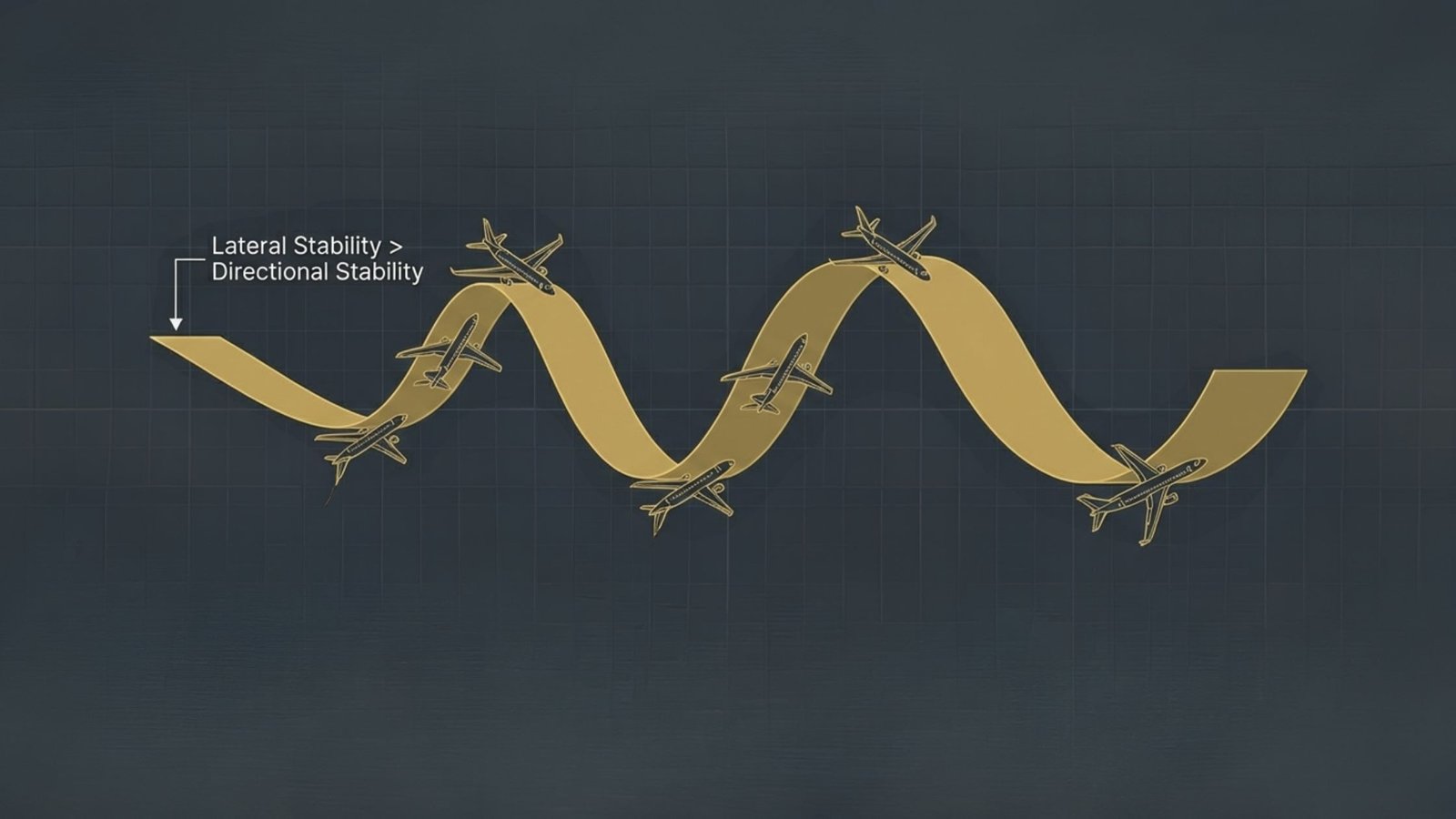
This lateral stability from dihedral also works in concert with the vertical tail’s directional stability, in a complex interaction that designers must balance perfectly.
——————————————————————————–
5. True Stability Isn’t Rigidity—It’s a Dance of Fading Oscillations.
When we talk about stability, it’s important to distinguish between static stability (the initial tendency to return to equilibrium) and dynamic stability (the response over time). When a stable aircraft is disturbed, it doesn’t just snap back to its original position instantly. Instead, it demonstrates what is known as positive dynamic stability.
Think of it like a plucked guitar string or a pendulum. It doesn’t just snap back to center; it moves past it and then corrects back, with each oscillation smaller than the last, until it comes to rest. For example, if the nose pitches up, it will pitch back down, overshoot slightly, then pitch up a little less, then down a little less, with each wave in this dance becoming smaller until the aircraft settles.
Understanding this principle is critical for pilots. New pilots who don’t grasp this concept often fall into a trap called “pilot-induced oscillations.” They try to correct a disturbance, but because they are fighting against the aircraft’s natural tendency to self-correct, they end up overcontrolling, making the oscillations worse.
“new pilots tend to overcontrol the aircraft when they’re first getting started. This is because they don’t understand that anytime you move the controls a stable airplane is going to try to move back to its original position and if you know that you’ll be ready for it and adjust your controls accordingly”
——————————————————————————–
Conclusion: A Symphony of Forces
Aircraft stability is a complex and elegant symphony of forces, relying on a stunning set of counter-intuitive principles, from intentionally nose-heavy designs balanced by downward-pushing tails to fighter jets engineered for pure instability. The next time you fly through turbulence, will you feel it as a random disruption, or as the start of a beautifully designed dance back to equilibrium?
——————————————————————————–
Resources
- 11 Learn To Fly | Straight & Level | What Is Directional Stability? – AvBriefs
- Aerodynamics of Flight 4 – Axes of Rotation & Stability – Cyrus Hung
- Aircraft Stability Explained (PPL Lesson 6) – Free Pilot Training
- Aircraft Stability | Theory of Flight | Physics for Aviation – Aero Guide
- Cm alpha curve| Longitudinal static stability| Static & Dynamic stability| Neutral Point – Concepts Unexplained
- Directional Stability Of Aircraft | Normal Axle Stability Of Aircraft | Lecture 40 – Airplane Tech Talk
- Directional stability – Total Training Support
- Directional stability| Intuitive explanation without equations – Concepts Unexplained
- Flight Dynamics Lecture 4.3 – Stability Derivative C_l_r – Luftvis Science
- How Does the Dihedral Effect Work in Aircraft? – Benjijart
- Static Lateral Directional Stability and Control – Brian Kish
- Understanding Airplane’s Longitudinal, Lateral & Directional Stability and the Need for Stabilizers! – JxJ AVIATION
- What is DIHEDRAL? – flight-club