1. Introduction: The “Air Data” Nerve Center
To navigate the skies with precision, a pilot needs a constant stream of “air data”—information regarding the aircraft’s speed, its height above the ground, and how quickly it is climbing or descending. This data isn’t gathered by cameras or GPS alone; it is powered by the very air the aircraft moves through, harnessed by the pitot-static system.
In the traditional instrument “Six Pack,” three instruments rely on gyroscopic principles, while the other three are pneumatic members of the pitot-static family:
- The Airspeed Indicator (ASI)
- The Altimeter
- The Vertical Speed Indicator (VSI)
As your instructor, I cannot overstate the importance of understanding these “pressure-powered” tools. While modern glass cockpits may use an Air Data Computer (ADC) to process this information, the physics remains the same. Understanding how air pressure translates into needles on a dial is the first step toward becoming a safe, technically proficient pilot.
——————————————————————————–
2. The Physics of Pressure: Static, Dynamic, and Total
The pitot-static system is built on the principles of Bernoulli’s Theorem, which describes how pressure changes within a moving fluid (or air). To make sense of our instruments, we must distinguish between three types of pressure:
- Static Pressure: Think of this as what the atmosphere “is.” It is the ambient pressure of the air molecules pressing on the aircraft from all sides, regardless of movement. Static pressure decreases as we climb because there is less air weight above us. On a standard day at sea level, this is 29.92″ Hg, decreasing by roughly 1″ Hg per 1,000 feet.
- Dynamic Pressure: This is what the airplane “feels” because of its motion. It is the “impact” pressure caused by air molecules hitting the aircraft as it moves forward. The faster you fly, the higher the dynamic pressure.
- Total Pressure (Pitot Pressure): This is the sum of Static + Dynamic pressure.
In plain English: Total pressure is the raw force of air hitting the front of the plane. To find out how fast we are actually going (Dynamic Pressure), the system must take that Total Pressure and subtract the ambient Static Pressure.
——————————————————————————–
3. The Hardware: Pitot Tubes and Static Ports
The aircraft “feels” the atmosphere through two primary sensors:
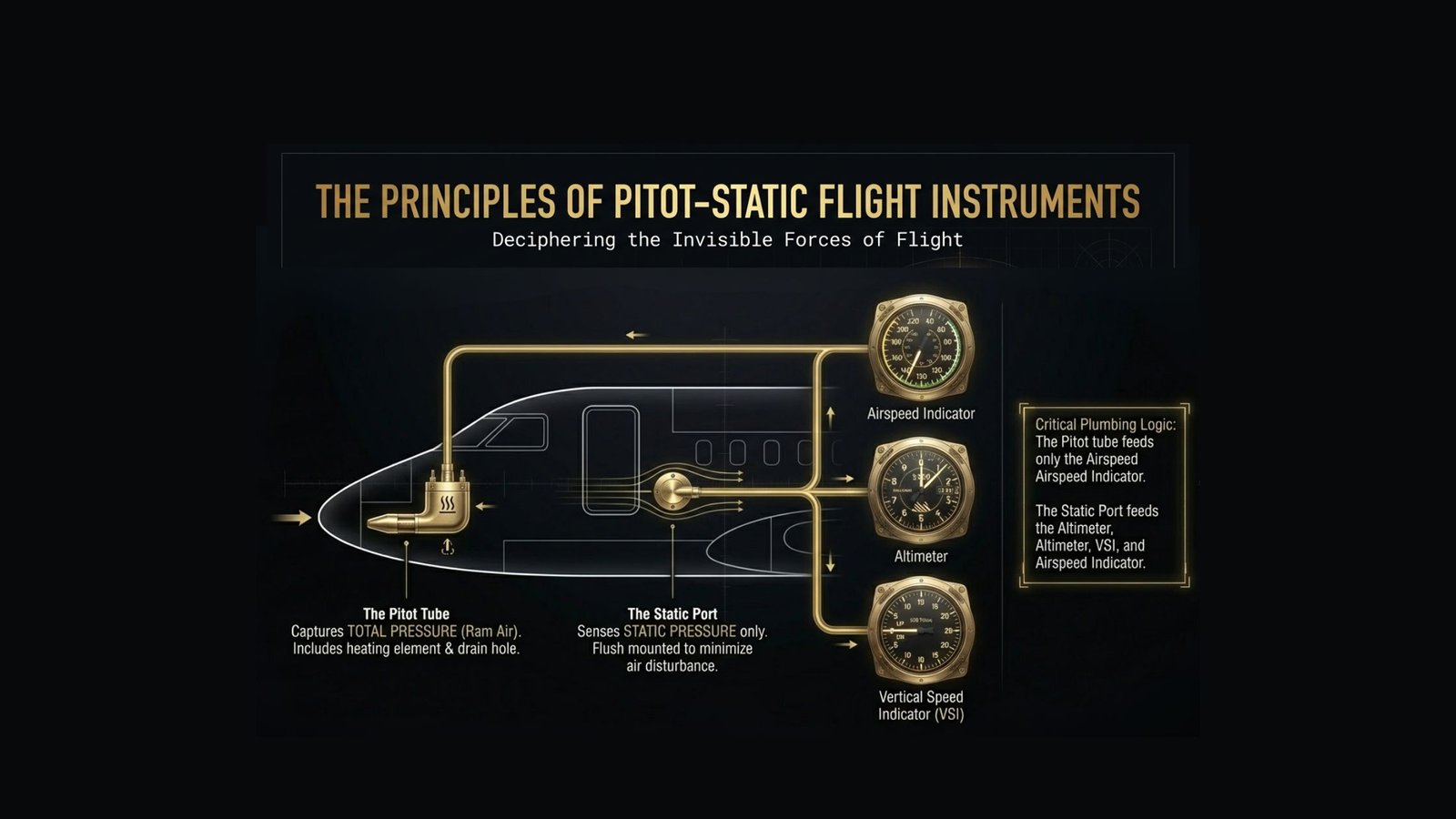
The Pitot Tube The pitot tube is a forward-facing probe—usually on the wing or nose—designed to catch the full force of the relative wind. It measures total pressure. Because it is open to the elements, it features a small drain hole (also called a “weeping hole”) at the back to allow moisture and rain to escape before they can enter the instrument lines.
The Static Port The static port is a small, flush-mounted vent on the side of the fuselage. It is placed in a location where the air is “undisturbed,” meaning it isn’t hit by the ram air of our forward motion. Its sole job is to provide a reference for static pressure.
Redundancy and Balance Many aircraft use dual static ports (one on each side). This balances out pressure changes during slips or skids, where air might “pile up” on one side of the fuselage. In multi-engine or transport-category aircraft, you will often find completely independent pitot-static systems for the pilot and co-pilot to provide redundancy.
——————————————————————————–
4. Deep Dive: The Altimeter (The Height Specialist)
The altimeter is essentially a high-precision barometer.
- Internal Mechanics: Inside the case is a stack of sealed aneroid wafers. These wafers are sealed with an internal pressure of 29.92″ Hg. Static air from the static port fills the instrument case around the wafers.
- The “Bag of Chips” Analogy: To visualize this, think of a sealed bag of potato chips. If you drive that bag from the beach up into the mountains, the bag will puff out. Why? Because the air pressure outside the bag is decreasing, allowing the trapped air inside to expand. The aneroid wafers do the exact same thing; as you climb, they expand, and as you descend, they contract.
- Pilot Instruction: This expansion and contraction move a mechanical linkage that turns the needles. However, because air pressure changes with the weather, you must use the Kollsman Window to manually set the local altimeter setting.
The Five Types of Altitude:
- Indicated: What you see on the dial.
- Pressure: The altitude when the Kollsman window is set to 29.92″ Hg (used in flight levels).
- Density: Pressure altitude corrected for non-standard temperature (critical for performance).
- True: Actual height above Mean Sea Level (MSL).
- Absolute: Actual height above the ground (AGL).
——————————————————————————–
5. Deep Dive: The Vertical Speed Indicator (The Rate Master)
The VSI measures how fast static pressure is changing. It is a “differential pressure” instrument.
- The Calibrated Leak: The VSI contains a diaphragm connected directly to the static line. The instrument case also receives static air, but it must pass through a calibrated leak (a tiny, restricted orifice).
- The Delay: When you climb, the pressure in the diaphragm drops instantly. But because of the restricted leak, the pressure in the case drops slowly. This temporary difference in pressure causes the diaphragm to move, showing a trend (the initial climb) and then a stabilized rate in feet per minute (fpm).
——————————————————————————–
6. Deep Dive: The Airspeed Indicator (The Speedometer)
The ASI is the only “true” pitot-static instrument because it requires both inputs to function. It calculates: Total Pressure – Static Pressure = Dynamic Pressure.
Inside the ASI, total pressure enters a diaphragm, while static pressure fills the case. The static pressure “cancels out” the static component of the total pressure, leaving only the dynamic pressure to expand the diaphragm and move the needle.
The “ICED-T” Mnemonic: To remember how we correct airspeed from the cockpit to the real world, use the mnemonic ICED-T:
- Indicated (IAS): Read directly from the instrument.
- Calibrated (CAS): IAS corrected for installation and position errors (found in your POH).
- Equivalent (EAS): CAS corrected for the compressibility of air (relevant at high speeds).
- True (TAS): The actual speed of the aircraft through the air mass (CAS corrected for non-standard temperature and pressure).
ASI Color Coding System | Marking | Meaning | | :— | :— | | White Arc | Flap operating range (Vso to Vfe). | | Green Arc | Normal operating range. | | Yellow Arc | Caution range (operate only in smooth air). | | Red Line | Never-exceed speed (Vne). | | Blue Line | Best rate of climb speed (Single-engine in multi-engine planes). |
——————————————————————————–
7. When Systems Fail: Blockages and Errors
Blockages are often caused by ice, dirt, or “nature’s mechanics”—insects.
Blocked Pitot (Drain Hole Open): The ram air is blocked, but the pressure can still escape through the drain hole. The pressure inside the ASI drops to match the static pressure, and the airspeed drops to zero.
Blocked Pitot and Drain Hole: Pressure is trapped. In level flight, the speed freezes. If you climb, the static pressure in the case drops while the trapped pitot pressure stays high, causing the diaphragm to expand. The ASI will act like an altimeter, showing an increase in speed during a climb and a decrease during a descent. This is extremely dangerous as it may lure a pilot into a stall during a climb.
Blocked Static Port:
- Altimeter: Freezes at the altitude where the blockage occurred.
- VSI: Settles at and remains at zero.
- ASI: Will read lower than actual speed when climbing above the blockage and higher than actual speed when descending below it.
The Cost of Failure: In 1996, Aeroperu Flight 603 crashed because the static ports were accidentally left covered with duct tape after maintenance. The pilots received conflicting data that made the aircraft impossible to fly safely in the dark.
——————————————————————————–
8. The Pilot’s Safety Toolkit
Pitot Heat: An electrical heating element used to melt ice. Pro-Tip: Never leave this on for long periods on the ground; without the cooling airflow of flight, it can reach several hundred degrees and burn out the heating element.
Alternate Static Source: If your external ports clog, you can switch to cabin air.
- The Dangerous Direction: Because of the suction caused by air moving around the fuselage, cabin air pressure is usually lower than outside air. This causes the Altimeter and ASI to read HIGHER than actual. You are lower and slower than the instruments say—a “dangerous direction” that could lead to a terrain strike or a stall.
Emergency “Glass Breaking”: If you have no alternate static source and your ports are iced, the last resort is to break the glass of the VSI. We sacrifice the VSI because it is the least critical of the three instruments.
Preflight Protocol:
- The “Wasp Nest” Rule: The crash of Birgenair Flight 301 was caused by a single wasp nest in a pitot tube. Always use “Remove Before Flight” covers and inspect ports for mud or insects during your walkaround.
- VSI Ground Check: During preflight, the VSI should read zero. If it reads, say, “100 fpm up” on the ground, that is your “new zero.” Note the error and apply it to your flight.
——————————————————————————–
9. Conclusion: The Importance of Cross-Checking
The pitot-static system is a marvel of simple engineering, but it is not infallible. Your best defense is a constant cross-check. During your takeoff roll, always verify that the airspeed is “active” and increasing before you are committed to the air. In a two-pilot cockpit, call out “80 knots” and verify that both instruments agree.
By understanding the physics of the air and the mechanics of your hardware, you can stay ahead of the airplane and keep “pucker factor” to a minimum. Safe flying!