
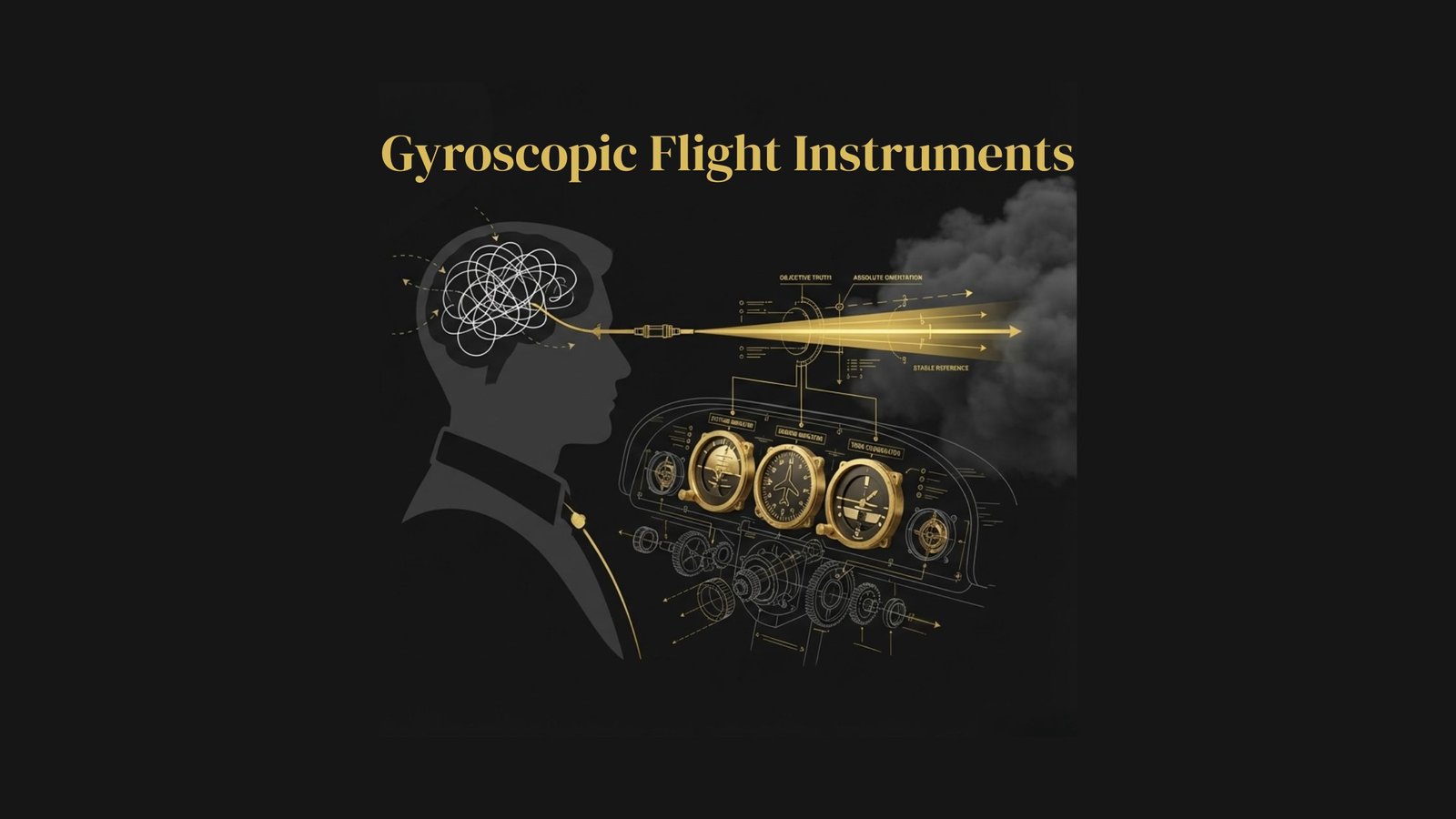
1. Introduction: Your Orientation when Senses Fail
In the cockpit, your biological senses are tuned for life on the ground, not for the three-dimensional maneuvers of flight. When you enter Instrument Meteorological Conditions (IMC)—flying through thick clouds or the void of a moonless night—your inner ear can easily deceive you. Without a visible horizon, your brain may insist you are straight and level while you are actually in a graveyard spiral.
This is why we rely on the “Six Pack” of primary flight instruments. While three of these rely on air pressure (the pitot-static system), the other three—the Attitude Indicator, the Heading Indicator, and the Turn Coordinator—serve as your “backup brain.” These instruments utilize the relentless laws of physics to provide a reliable reference when your own senses fail.
2. The Anatomy of a Gyroscope
At its core, a gyroscope is a spinning mass that leverages inertia to maintain its orientation. To understand these instruments, we must distinguish between the two types used in the cockpit: Displacement Gyros (the Attitude and Heading indicators) which measure the aircraft’s position relative to a reference, and Rate Gyros (the Turn Coordinator) which measure the speed of the aircraft’s movement.
Every mechanical gyro consists of three primary components:
- The Rotor: A heavy, symmetrical disc or wheel. To maximize stability, most of its mass is concentrated on the outer rim.
- The Gimbals: These are circular support frames that allow the rotor to tilt and rotate. Depending on the instrument, these provide the “degrees of freedom” necessary for the aircraft to move around the rotor.
- The Frame: The rigid housing attached directly to your instrument panel.
The fundamental secret of gyroscopic flight is this: the spinning rotor stays fixed in space, while the airplane and the instrument case literally rotate around it.
3. The Two Fundamental Principles: Rigidity and Precession
As a pilot, you don’t just need to know that they work; you need to know why they behave the way they do.
3.1 Rigidity in Space
This principle states that a spinning rotor will maintain its axis of rotation and resist any attempt to tilt it. Think of a bicycle wheel: when stationary, it’s flimsy; when spinning at high speed, it resists being turned by the handlebars. Rigidity is governed by two factors:
- RPM (Rotational Speed): The faster it spins, the more rigid it is.
- Moment of Inertia: Determined by the mass and radius of the rotor.
3.2 Precession
Precession is the reaction of a spinning object to an external force. This reaction occurs 90 degrees later in the direction of rotation. The Cockpit Connection: Consider “propeller yaw.” When you pitch a tail-wheel aircraft up during takeoff, you are applying a force to the bottom of the clockwise-spinning propeller. Because of precession, that force acts 90 degrees later (on the right side), pushing the nose to the left. This is exactly why you’ll hear me reminding you to apply right rudder during a climb—you are manually correcting for gyroscopic precession.
4. Powering the Gyros: Vacuum vs. Electric Systems
Reliability in aviation comes from redundancy. If your engine fails, you don’t want to lose every instrument simultaneously.
| Power Source | Instruments Powered | Advantages | Disadvantages |
| Engine-Driven Vacuum | Attitude Indicator, Heading Indicator | High performance; spins rotors at very high RPM. | Fails if the engine or pump fails; requires 4.5 to 5.5 ” Hg suction to be reliable. |
| Venturi System | Various (Vintage Aircraft) | Simple; no moving engine parts; works if engine fails. | Drag-inducing; won’t work on the ground; requires high airspeed to spin up. |
| Electric System (DC) | Turn Coordinator | Provides vital redundancy; works independently of engine/vacuum failures. | Smaller motors; more reliable and consistent than vacuum, though often lower peak RPM in light aircraft. |
By powering the Turn Coordinator electrically while the other two are vacuum-driven, you ensure that a single system failure won’t leave you “blind” in the clouds.
5. The Attitude Indicator (The Artificial Horizon)
The Attitude Indicator is a Displacement Gyro that utilizes a horizontal rotor (spinning on a vertical axis) at approximately 18,000 RPM. It relies on Rigidity in Space to provide a constant reference to the earth’s horizon.
Because even the best bearings have friction, the AI uses an internal “erecting mechanism” known as Pendulous Vanes. These vanes use gravity to constantly and automatically correct the gyro, keeping it perfectly vertical over time.
The Instrument Face:
- Shading: Blue represents the sky; brown or black represents the ground.
- Bank Index: Markings at the top for 10°, 20°, 30°, 45°, 60°, and 90° of bank.
- Pitch Ladder: Graduated in 5° and 10° increments.
- Miniature Airplane (“The Pipper”): You can adjust this white or orange bar to align with the horizon line based on your seating height.
6. The Heading Indicator (Directional Gyro)
This is another Displacement Gyro, but it uses a vertical rotor (spinning on a horizontal axis) at roughly 12,000 RPM to sense yaw. Unlike a magnetic compass, it is stable and doesn’t swing during acceleration or turns.
However, it is a “free gyro” with no magnetic properties. Because of internal friction and the Earth’s rotation, it will suffer from Precession Error (drift). You must reset it to the magnetic compass roughly every 15 minutes. Pro-Tip: During a high-workload approach, it is easy to forget this reset. This is dangerous, as your primary directional reference could be off by several degrees. Always perform the reset in straight-and-level, unaccelerated flight to ensure the magnetic compass itself is reading accurately.
7. The Turn Coordinator and Turn & Slip Indicator
These are Rate Gyros, meaning they measure the speed of a change rather than the position.
- Turn & Slip Indicator: Uses a horizontal rotor to sense only the rate of turn. Pilots often refer to the reference marks as the “Doghouse.”
- Turn Coordinator: Features a canted (30°) rotor. This allows it to sense both the Rate of Roll and the Rate of Turn.
Crucial Safety Detail: Because the Turn Coordinator is often the only electric gyro in a standard panel, it features a “Red OFF Flag.” If you see that flag, the instrument has lost power. In IMC, this flag is a life-saver—it tells you instantly that the instrument is no longer reliable.
The Math: A Standard Rate Turn is 3° per second. This results in a “2-Minute Turn” (360° of rotation). If your wingtip is on the index, you can precisely time your navigation.
8. The Inclinometer: Maintaining Coordinated Flight
At the bottom of the Turn Coordinator is the inclinometer—the “ball in the tube.” It is important to remember that the inclinometer is not gyroscopic. It is a simple glass tube filled with dampening fluid (kerosene) and a steel ball that reacts to gravity and centrifugal force.
- Coordinated: The ball is centered.
- Slipping: The ball falls to the inside of the turn (centripetal force > centrifugal force).
- Skidding: The ball is flung to the outside (centrifugal force > centripetal force).
Your corrective action is always: “Step on the ball.” If the ball is displaced to the right, apply right rudder until it returns to the center.
9. Operational Limits, Errors, and Maintenance
These instruments are marvels of engineering, but they are delicate.
- Tumbling: Older mechanical gyros have physical limits. If you exceed approximately 60°–70° in pitch or 100°–110° in bank, the gimbals hit their stops and the gyro “tumbles,” spinning the display violently. Note that modern digital AHRS systems do not tumble, as they lack mechanical gimbals.
- Spin-up/Spin-down: Always allow 5 minutes for gyros to reach full RPM before takeoff. During shutdown, listen for grinding or whining; a healthy gyro should have a smooth, quiet spin-down that lasts several minutes.
- Cleanliness: Ensure your air filters are changed regularly. Dust in the bearings increases friction, which directly increases precession error and reduces the lifespan of the instrument.
10. Conclusion: The Future of Gyroscopic Flight
We are currently in a transition period in aviation. Modern aircraft are replacing mechanical rotors with AHRS (Attitude and Heading Reference Systems). These use solid-state micro-sensors and lasers to determine orientation, eliminating mechanical wear and the risk of tumbling.
However, whether you are flying a legacy “Six Pack” or a state-of-the-art glass cockpit, the underlying physics remains the same. Understanding rigidity and precession isn’t just for passing your checkride—it’s about knowing how to talk to your “backup brain” when the world outside the windscreen disappears. Fly coordinated, keep your vacuum in the green, and trust your instruments.