
As someone who has spent decades both in the maintenance hangar and the cockpit, I have seen first-hand that a pilot’s confidence is built on understanding the machinery that keeps them aloft. The aircraft ignition system—specifically the high-tension magneto—is a masterclass in independent engineering. It is a dual-natured beast: acting first as an electric generator that transforms mechanical energy into electromagnetic energy, and second as an induction coil that suddenly delivers that energy at a voltage high enough to jump the spark plug gap. Because it is geared directly to the engine’s crankshaft, it operates independently of the aircraft’s primary electrical system, ensuring that even if you lose every light and radio in the panel, the engine keeps humming.
1. The Four Pillars of the Ignition System
To master the system, one must understand the four primary components that make the “fire” happen:
- The Magnetos: Mounted to the gearbox at the back of the engine, these units are mechanically geared to the crankshaft. They use spinning magnets to convert mechanical rotation into high-voltage current. Most certified aircraft utilize a dual-magneto system (Left and Right) for safety.
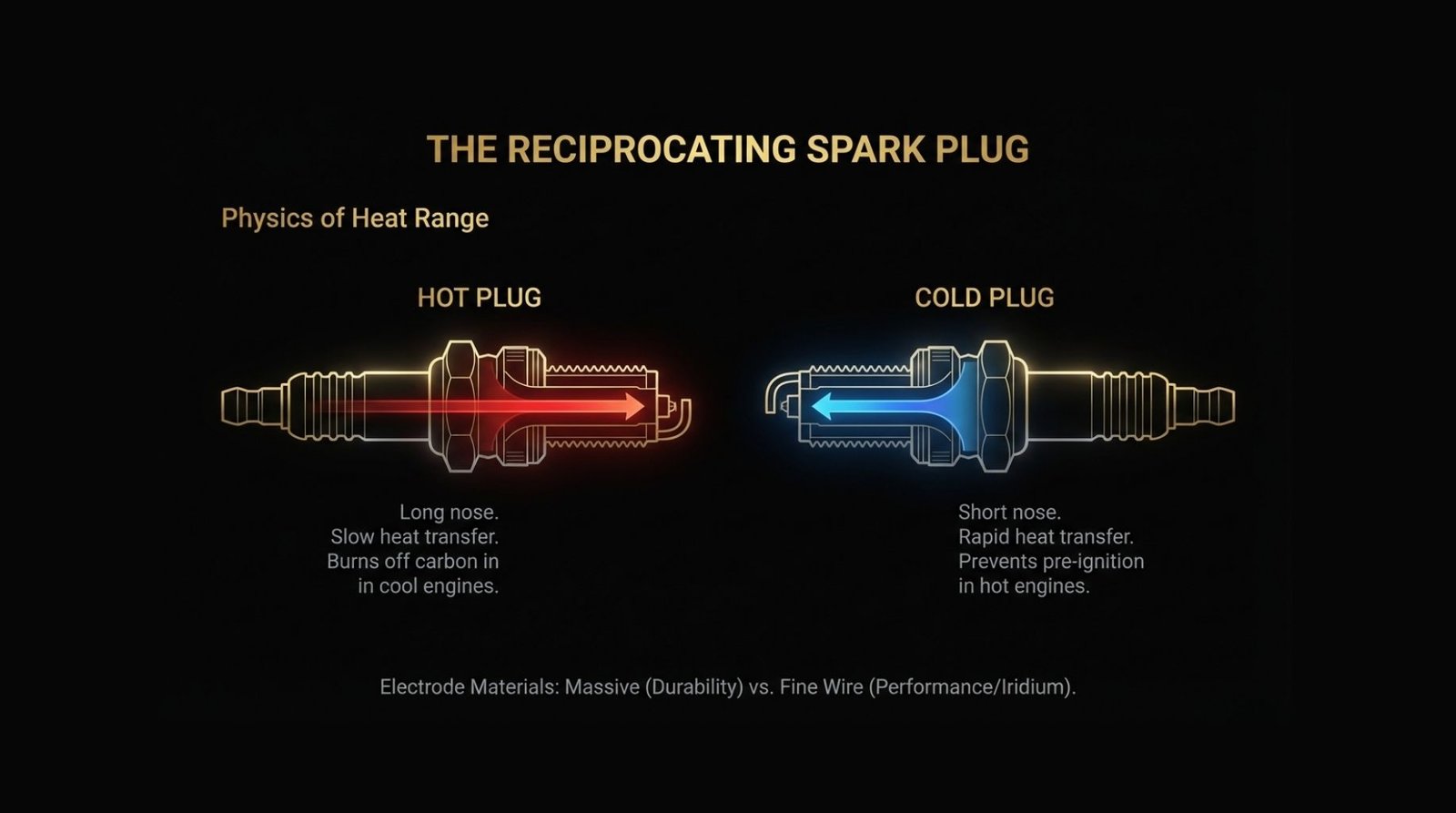
- The Spark Plugs: We typically run two spark plugs per cylinder. This isn’t just for backup; it provides a more even, efficient burn of the fuel-air charge, resulting in smoother power delivery.
- The Wires: These are the conduits for high-voltage energy. They are often color-coded for maintenance clarity; for instance, green wires typically route to the top spark plugs while blue wires route to the bottom.
- The Ignition Switch: In a standard rotary switch, you have five positions: Off, R, L, Both, and Start.
- Off: This position grounds the magneto through the “P-lead.” By grounding the primary circuit, we prevent the magneto from ever reaching a “break” point, thus stopping the spark. A broken P-lead results in a “hot mag,” a serious safety hazard where the engine can fire if the prop is moved.
- Start: This engages the starter motor. Crucially, the magnetos “retard” their spark during this phase. This delay ensures the spark occurs after the piston has passed Top Dead Center, preventing the engine from “kicking back” against the starter during slow-speed cranking.
2. Safety Through Redundancy: The “What-If” Scenario
In aviation, we live by redundancy. If the right magneto fails in flight, the left magneto continues to fire all cylinders—utilizing its specific wiring (e.g., green wires to the top of cylinders 1 and 3, and blue to the bottom of 2 and 4).
However, there is no free lunch. When running on a single magneto, the combustion process is less efficient, and the engine will produce less power. This is exactly why we perform a “mag check” during the pre-flight run-up. By selecting only one magneto at a time, we look for a specific, slight drop in RPM. If the drop is too great—or if there is no drop at all—we know we have a maintenance issue that must be addressed before the wheels leave the tarmac.
3. The Science of the Spark: Five Periods of Operation
According to NACA Report No. 123, the operation of a magneto follows a distinct five-period cycle. Understanding these helps diagnose why a system might be underperforming:
- Period 1 (Current Generation): The breaker contacts are closed, and the rotating magnet builds current in the primary winding.
- Period 2 (Voltage Build-up): The contacts open (I0 represents the current at the instant of break). Voltage rises rapidly to a maximum (Vm). If your breaker contacts are pitted or dirty, the system may never reach the “crest voltage” required to bridge the gap.
- Period 3 (Condenser Discharge): The spark gap at the plug breaks down, causing an initial rush of current as the energy stored in the condenser is released.
- Period 4 (Coil Discharge): This is the “sustained spark.” NACA oscillograms show that during this period, the voltage remains “substantially constant” even as the current decreases linearly. This duration is what ensures the fuel-air mixture actually ignites.
- Period 5 (Extinguishing): As the breaker contacts close again, the current is shifted back to the primary circuit, rapidly extinguishing the spark and preparing for the next cycle.
4. Technical Analysis: Factors Affecting Spark Performance
As an engineer, I look at the variables that degrade Vm. The following data, distilled from NACA’s experimental examples, shows how sensitive the system is to poor maintenance or improper installation:
| Factor | Impact on Crest Voltage (Vm) | Engineering Context |
| Increased Lead Capacity | 46% Decrease | Specifically observed when adding 2-meter leads to the high-voltage circuit. |
| Dirty Distributor | 43% Reduction | Resulting from 500,000 ohms of shunting resistance (carbon tracking/dirt). |
| Primary Condenser Size | 5.9% Gain | Observed when reducing primary condenser capacity, though this risks excessive contact arcing. |
5. Maintenance and Resource Guide
Maintaining Continental S-20/S-200 series magnetos requires strict adherence to the manufacturer’s Service Support Manual (Publication X42002-3).
Service Document Hierarchy
Continental categorizes its instructions based on safety impact. Note the critical link between manufacturer data and federal law:
- Category 1: Mandatory Service Bulletin (MSB): Addresses known safety hazards. These are frequently incorporated into FAA Airworthiness Directives (ADs), making compliance a legal requirement.
- Category 2: Critical Service Bulletin (CSB): Identifies conditions threatening safe operation. These are primary candidates for future ADs.
- Category 3: Service Bulletin (SB): Improvements to inherent safety or updates to instructions for continued airworthiness.
- Category 4: Service Information Directive (SID): Manufacturer direction to enhance safety, maintenance, or economy.
- Category 5: Service Information Letter (SIL): General useful information or optional component updates.
- Category 6: Special Service Instruction (SSI): Issues limited to specific models or serial numbers.
Approved Parts Identification
To ensure airworthiness, owners must verify that replacement parts are identified by:
- FAA Form 8130-3 (Airworthiness Approval Tag).
- FAA Technical Standard Order (TSO) markings.
- FAA/PMA symbols with the manufacturer’s trademark and part number.
- Official shipping tickets/invoices from an FAA-approved production system.
- A certificate of airworthiness for export from a foreign government.
Technical Advisories
In our manuals, pay close attention to these formatting cues:
- WARNING: Disregarding this can result in severe injury or total equipment failure.
- CAUTION: Disregarding this may result in damage to the engine or its accessories.
- NOTE: Provides information to facilitate a specific procedure.
6. Conclusion: The Pilot’s Responsibility
The reliability of your ignition system is not a matter of luck; it is a matter of compliance. The first 25 hours of operation are the “Break-In” period, where monitoring engine operating indicators is vital. Always conduct ground run-ups in strict accordance with your Pilot’s Operating Handbook (POH). Ultimately, the owner/operator is the final authority for the continued airworthiness of the aircraft. Use only approved parts, stay current on Service Bulletins, and respect the “P-lead”—because a well-maintained magneto is the literal heart of flight.
——————————————————————————–
References and Technical Sources
- Epic Flight Academy: PPGS Lesson 6.8 (Aircraft Systems: Ignition Systems).
- Continental Motors: S-20/S-200 Series High Tension Magneto Service Support Manual (Publication X42002-3).
- NACA Report No. 123: Simplified Theory of the Magneto (F.B. Silsbee).