1. Introduction: The Critical Role of the Aircraft Fuel System
As a senior systems engineer, I cannot overstate that the fuel system is the lifeblood of an aircraft. Its primary mission is to deliver a constant, precisely metered supply of clean fuel to the engine under every conceivable flight condition, from sea-level taxiing to high-altitude cruise at 10,000m, and across the full spectrum of global climates.
Modern aerospace design categorizes fuels based on the powerplant: AVGAS is utilized for reciprocating engines, primarily found as Grade 80 (dyed red) or 100LL (dyed blue). While “LL” stands for low lead, it is a technical distinction; 100LL actually contains four times the lead content of Grade 80. Turbine engines utilize Jet A, a kerosene-based fuel ranging from clear to straw in color. Beyond simple delivery, the modern engineer must design for complex challenges including Vapor Lock, induction icing, and the management of flammability through advanced tank Inerting and thermal management.
2. Core Architecture and Components
To understand the system’s complexity, we must distinguish between the Airframe Fuel System (which manages storage and delivery to the engine) and the Engine Fuel System (which manages high-pressure pumping and precise metering into the cylinders or combustion chamber).
Standard System Components:
- Tanks: Primary storage units integrated into the airframe.
- Boost Pumps: Essential for maintaining pressure in the lines, aiding in the release of trapped vapors, and preventing pump cavitation.
- Lines and Selector Valves: Managed from the flight deck to route fuel from specific tanks or facilitate crossfeed operations.
- Strainers and Gascolators: Critical filtering units located at the system’s lowest point to trap water and solid contaminants.
- Engine-Driven Pumps: High-capacity pumps that deliver fuel to the metering device at specified pressures.
In sophisticated 3D system architecture, we utilize a vertical hierarchy for fluid and gas management. Simulation data confirms that the Vent Tank must be positioned at the highest origin, followed by the Wing Tank, with the Center Tank at the lowest vertical origin to ensure proper drainage and venting dynamics.
3. The Science of Fuel Metering and Carburetion
The Venturi Principle and Metering Force
The mechanical regulation of fuel relies on the Venturi Principle. As air enters the narrow throat of a carburetor’s venturi, its velocity increases, creating a proportional drop in pressure. This creates a Metering Force—the differential between the atmospheric pressure in the fuel bowl and the low pressure in the venturi. Critically, a pressure differential of 0.5 “Hg is required just to raise the fuel to the discharge nozzle level and overcome its surface tension.
Air-Fuel Mixture Ratios
Engine performance is dictated by the ratio of air to fuel by weight, a necessity because air density changes significantly with altitude. For perspective, at 18,000 ft, air is only half as dense as it is at sea level, meaning a cylinder contains only half the oxygen mass for the same volume.
| Mixture Type | Ratio/Decimal | Characteristics |
| Stoichiometric | 15:1 (0.067) | The chemically perfect ratio; all oxygen and fuel are consumed, resulting in the highest combustion temperatures. |
| Best Power | 0.0725 – 0.080 | Greatest power for a given airflow; excess fuel speeds up combustion and adds mass to the charge. |
| Best Economy | 0.060 – 0.065 | Least fuel flow for a required horsepower; used during cruise to minimize Specific Fuel Consumption (SFC). |
Carburetor Subsystems and Configurations
Engineers select carburetor orientations based on airframe constraints: Updraft (air flows upward), Downdraft (air flows downward), or Side-draft (horizontal entry). Regardless of orientation, a flight-ready carburetor requires six essential subsystems:
- Main Metering: Regulates fuel at all speeds above idle.
- Idling: Supplies fuel when the throttle is closed and venturi velocity is insufficient.
- Accelerating: Prevents a temporary “lean out” during rapid throttle advancement.
- Mixture Control: Allows the pilot or an Automatic Mixture Control (AMC) to adjust for air density.
- Idle Cutoff: Stops all fuel flow to prevent Detonation or accidental “kick-over” during shutdown.
- Power Enrichment (Economizer): Automatically enriches the mixture during high-power operations to provide internal cylinder cooling.
4. Advanced Safety: Managing Vapor Lock and Icing
Vapor Lock
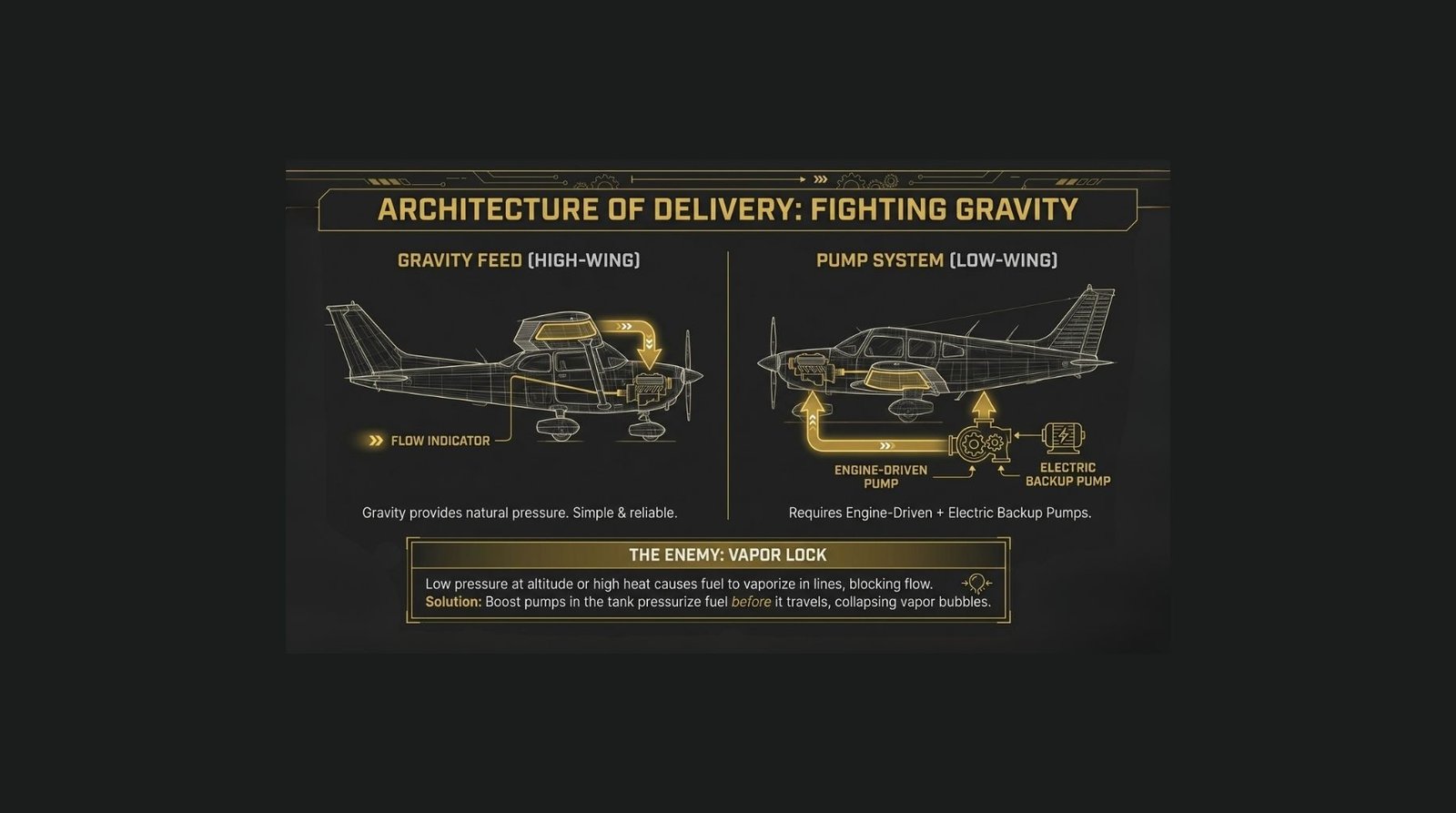
Vapor Lock occurs when fuel vaporizes prematurely in the lines, restricting the flow of liquid fuel. This is most dangerous during a rapid climb on a hot day. In this scenario, the fuel retains takeoff heat while the ambient pressure drops rapidly, significantly lowering the fuel’s boiling point. Mitigation is achieved through Booster Pumps, which keep fuel under pressure and force vapors back to the tank to be released through vents.
Carburetor Icing
Induction icing is a silent threat that can occur even in warm weather:
- Fuel Evaporation Ice: Caused by the temperature drop during vaporization. This can occur in ambient temperatures as high as 100°F.
- Throttle Ice: Forms on the rear of the throttle valve due to low-pressure cooling; it is rarely a threat above 38°F.
- Impact Ice: Formed by moisture (snow or sleet) impinging on cold surfaces. The most dangerous accumulation point is the Carburetor Screen, which can lead to a rapid and total loss of engine power.
5. Modern Safety Validation: Fuel Tank Inerting Systems
To eliminate flammability risks, modern aircraft utilize Inerting systems. These systems replace the oxygen-rich air in the tank “ullage” (the space above the fuel) with Nitrogen-Enriched Air (NEA).
In a standard safety simulation, we model the internal medium as a mixture of steam, oxygen, nitrogen, and Jet A. We use two specific air sources: Source_Vent (ambient air with 20% oxygen / 80% nitrogen) and Source_NEA (the inerting gas with 2% oxygen / 98% nitrogen). To ensure the AMC bellows accurately compensate for altitude, they are sealed at an absolute pressure of 28 “Hg. This ensures that as the aircraft transitions from 0m to 10,000m, the oxygen mass fraction remains below the flammability limit, even as the fuel acts as a Thermal Sink for engine heat.
6. Innovation in Design: Simulation and Fuel Injection
Fuel Injection Advantages
Modern designs favor Fuel-Injection Systems (like the Bendix/Precision RSA series) over carburetors. These systems offer:
- Improved Acceleration: Due to positive, pressurized fuel delivery.
- Optimized Distribution: Eliminates the risk of individual cylinders running lean and overheating.
- Reduced Icing Risk: By injecting fuel directly at the cylinder intake, the cooling effect of vaporization is removed from the induction throat.
Model-Based Design and Simulation
Engineering productivity has been revolutionized by tools like Modelon Impact, which allow for high-fidelity Model-Based Design. We no longer rely on physical prototypes for early-stage validation. Modern capabilities include:
- STL File Integration: Importing complex tank geometry directly from CAD.
- Flow Dynamics: Using geometrically parameterized flanges between tanks and pipes for precise flow modeling.
- Center of Gravity (COG): Computing the fuel COG for individual tanks and the aggregate system across all flight attitudes.
- Mass Fraction Monitoring: Real-time visualization of nitrogen and oxygen levels during climb-out to validate safety thresholds.
7. Conclusion: The Future of Precise Fuel Management
The transition from mechanical estimation to high-precision scheduling is now complete through the use of Electronic Engine Controls (EEC). These digital computers interactively sense parameters such as Compressor RPM, Exhaust Gas Temperature (EGT), and Combustion Chamber Pressure to determine the exact fuel required. By synthesizing robust mechanical principles with digital simulation and electronic oversight, we ensure the highest levels of efficiency and safety from the moment of takeoff through the high-altitude transition to 10,000m.