1. Introduction: The Heart of Propulsion
In the hangar, we often say that an engine is just a high-tech noise-maker until you hang a propeller on it. The propeller is the component that converts the engine’s rotational energy into forward thrust. To understand how it works, think of it as a “Rotating Wing.” Just like the wings of an aircraft, each propeller blade is a sophisticated airfoil. As it spins, it creates a pressure differential—lower pressure in front and higher pressure behind—displacing air backward and pulling the aircraft forward. Without this integral part, flight isn’t just difficult; it’s impossible.
2. Propeller Nomenclature: Understanding the Parts
As a technician, you don’t just look at a propeller; you “read” it. Understanding the anatomy is the first step in proper maintenance and inspection.
- Hub: The central attachment point that secures the blades to the engine crankshaft or propeller shaft.
- Propeller Information: On the hub of a metal propeller, you will find critical data stamped, including the Serial Number, Model Number, and FAA Type Certificate (TC). For an AMT, this is the legal DNA of the component.
- Blade Tip: The portion furthest from the hub, generally defined as the last 6 inches.
- Leading & Trailing Edges: The leading edge is the thick edge that meets the air first; the trailing edge is the thin rear edge.
- Blade Face & Back: The Blade Face is the flat side (the side facing the pilot), while the Blade Back is the cambered or curved side (the side facing away from the aircraft).
- Shank & Butt: The Shank is the thick, rounded portion near the hub providing structural strength. The Butt (also called the base or root) is the very end that fits into the hub.
- Camber & Chord Line: Camber refers to the curve of the airfoil surfaces. The chord line is the imaginary straight line connecting the leading and trailing edges.
3. Aerodynamics and Physical Forces
The Physics of Thrust
The propeller converts brake horsepower from the engine into thrust horsepower. No system is perfect; Propeller Efficiency (\eta) is the ratio of thrust horsepower to brake horsepower, typically ranging from 50% to 87%.
Forces at Play
There are five primary forces acting on a rotating propeller that every educator should emphasize:
- Centrifugal Force: The most dominant force, tending to pull the blades right out of the hub.
- Torque Bending: Air resistance that bends blades opposite the direction of rotation.
- Thrust Bending: The load that tends to bend the blades forward as they pull the aircraft.
- Aerodynamic Twisting Moment (ATM): Tends to turn the blades toward a high pitch.
- Centrifugal Twisting Moment (CTM): Tends to turn the blades toward a low pitch.
- Note for Students: CTM is naturally greater than ATM and is the primary force used to move blades toward a low-pitch position.
Pitch and Slip
The theoretical advance of a propeller vs. its actual performance is measured by the following:
| Term | Definition |
| Geometric Pitch | The theoretical distance a propeller advances in one revolution. Formula: 2 \times \pi \times R \times \text{tangent of blade angle} (calculated at the 75% station). |
| Effective Pitch | The actual distance the propeller advances through the air during flight. |
| Slip | The difference between Geometric and Effective pitch. |
4. Categories of Aircraft Propellers
- Fixed-Pitch: The blade angle is built-in and unchangeable.
- Wood: Built from laminated layers (usually 5 to 9) of hardwoods. The most widely used is Yellow Birch, though Black Cherry, Sugar Maple, and Oak are also utilized.
- Metal: One-piece forged anodized aluminum alloy. These allow for thinner, more efficient sections.
- Ground-Adjustable: Operates like a fixed-pitch, but the angle can be changed while the aircraft is stationary by loosening a clamping mechanism.
- Controllable-Pitch: Allows the pilot to manually change the blade angle while the propeller is rotating to match flight conditions.
- Constant-Speed: Uses a Governor to automatically adjust pitch to maintain a preset RPM. This ensures the engine operates at peak efficiency whether you are in a climb or a dive.
- Feathering: Used on multi-engine aircraft to turn the blades parallel to the flight path (approx. 90°) if an engine fails. This stops the propeller from “Windmilling” and minimizes drag.
- Reverse-Pitch: Blades move into a negative angle to create reverse thrust, providing aerodynamic braking after landing.
- Test Club Propeller: A specialized multi-blade propeller used on the ground to provide the correct load for engine break-ins while ensuring maximum cooling airflow.
Propeller Location: Tractor vs. Pusher
Most aircraft use a Tractor configuration, where the propeller is in front of the structure. This allows the blades to rotate in relatively undisturbed air, inducing lower stresses. Pusher propellers are mounted behind the structure. While common on seaplanes, they are highly susceptible to erosion and damage from debris thrown up by the wheels.
5. Design Constraints and Trade-offs
The “Twisted Airfoil” design is technically known as Pitch Distribution. Because the tip travels much faster than the hub, the blade is twisted to have a higher angle at the hub and a lower angle at the tip. This maintains a uniform angle of attack and thrust across the entire blade.
Designers are limited by two major factors:
- Ground Clearance: Physical space between the tip and the runway.
- Tip Speed: Efficiency is lost as tips approach the speed of sound (Mach 1). Due to these compressibility issues, propeller-driven aircraft are generally limited to speeds of approximately 400 mph.
To absorb higher engine horsepower without hitting Mach 1, we add more blades (up to 6). It’s a “necessary evil” that adds weight and drag but handles the power.
6. Propeller Auxiliary Systems
- The Governor: An RPM-sensing device and high-pressure oil pump. The pilot uses the cockpit control to set the Speeder Spring tension, which establishes the maximum RPM the governor will allow before the flyweights overcome the spring to increase pitch.
- Ice Control: Anti-icing systems use a pump and “slinger rings” to distribute fluids like Isopropyl Alcohol or phosphate compounds. Modern Deicing systems use electric heater boots to melt the bond of ice already formed.
- Synchronization & Synchrophasing: These match engine RPM and set a specific blade phase relationship to reduce the “beat” of cabin noise.
- Autofeather: Automatically feathers the blades if sensors detect a loss of engine torque, a critical safety feature during takeoff.
7. Maintenance and Safety Inspections
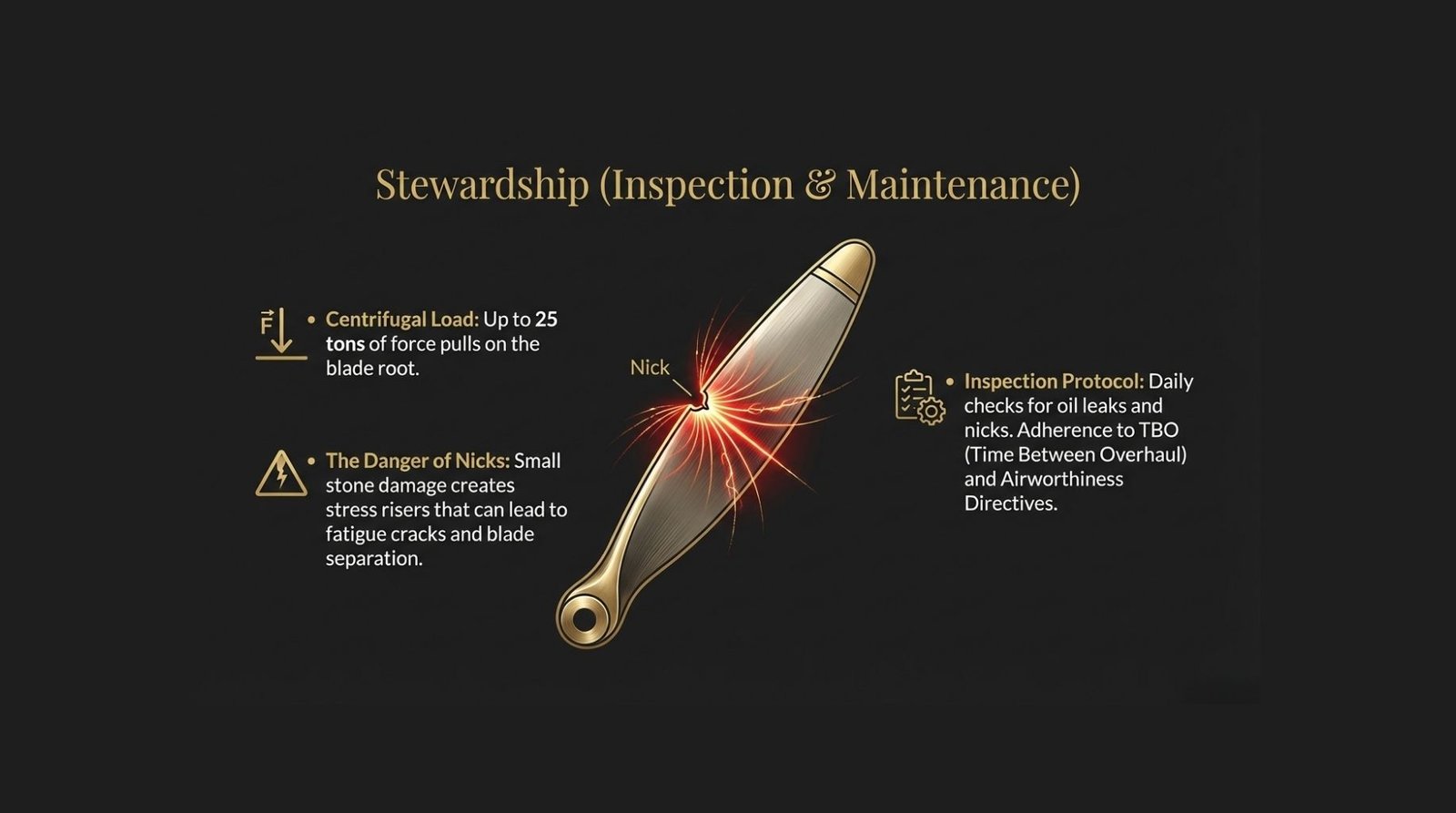
A propeller is under immense stress. The blade face is subjected to constant tension from centrifugal force. Consequently, a tiny nick or scratch is a “stress riser” that can lead to catastrophic failure.
AMT Inspection Checklist:
- Nicks and Cracks: Meticulously inspect the leading edge using a magnifying glass. Small nicks must be dressed out to prevent fatigue cracks.
- Tachometer Accuracy: This is vital. Accuracy must be verified every 100 hours or at the annual inspection. An inaccurate tachometer can lead to overstressing the blades.
- Wood Propeller Specifics: Inspect for glue failure, finish delamination, and “charring” between the propeller and the flange—a classic sign of loose mounting bolts. Ensure the drain holes in the metal tipping are clear.
- Compliance: Always verify the logbook for current Airworthiness Directives (ADs) and Service Bulletins (SBs).
8. Industry Resources and Manufacturers
Propeller Manufacturers
- Hartzell Aviation
- McCauley (Textron Aviation)
- Signia Aerospace
Maintenance, Repair, and Overhaul (MRO)
- Quality Aircraft Accessories (QAA)
- Acorn Welding (Exhaust & Custom Fabrication)
- Aerospace Welding
Engine Accessory Brands
- Aeroforce: Turbocharging Systems
- Sky-Tec: Starters
- Plane-Power: Alternators
- Janitrol Aero: Heating Systems
- Fuelcraft: Fuel Systems
- PowerUP Ignition: Ignition Systems