1. Introduction: The Lifeblood of the Engine
In my decades as a powerplant engineer and flight instructor, I’ve noticed that while student pilots obsess over fuel levels and flight manifests, they often treat engine oil as a secondary concern. That is a mistake. If fuel is the energy that powers an aircraft, oil is the “lifeblood” that ensures its survival. In the high-stress environment of an aviation powerplant, metal components operate under extreme loads and rotational speeds. Without a robust system to manage this fluid, an engine would face catastrophic structural failure within minutes.
As an engineer, I look at lubrication through the lens of system architecture. Most aircraft utilize one of two primary methods: the Wet Sump or the Dry Sump system. The choice isn’t just about cost; it’s about the aircraft’s mission. Whether you are flying a standard trainer or a high-performance turbine, understanding these systems is vital for operational safety and engine longevity.
2. Beyond Lubrication: The Multi-Functional Nature of Engine Oil
It is a common misconception that oil exists solely to make parts “slippery.” While reducing friction is a primary task, engine oil is a multi-tasking medium with several critical roles:
- Lubrication: Creating a film between moving parts to replace metallic friction with internal fluid friction.
- Cooling: Dissipating heat away from internal components. In reciprocating engines, components like pistons and cylinder walls are especially dependent on oil for heat transfer.
- Cleaning: Carrying away combustion by-products and contaminants to a filter.
- Protection: Coating internal surfaces to prevent corrosion and oxidation—a reason why engines shouldn’t sit idle for long periods.
- Sealing: Forming a seal between the piston and cylinder wall to prevent combustion gas leakage.
- Hydraulic Medium: Acting as fluid power for variable-pitch propellers and reducing vibration between the crankshaft and bearings.
- Indicating Medium: This is critical for the pilot. The oil system serves as an early warning system; abnormal pressure or temperature readings are often the first signs of mechanical failure or impending power loss.
Engineer’s Note on Jet vs. Piston Oils: While both systems share these goals, the priority shifts based on the engine type. In Jet Engines, the functional breakdown is highly specialized: 90% of the oil’s role is heat transfer, 5–10% is friction reduction, and 2–3% covers sealing and protection. Piston engines, by contrast, rely much more heavily on oil for the lubrication of high-clearance moving parts and maintaining a film under the shock-loading of the power stroke.
3. The Wet Sump System: Simple and Integrated
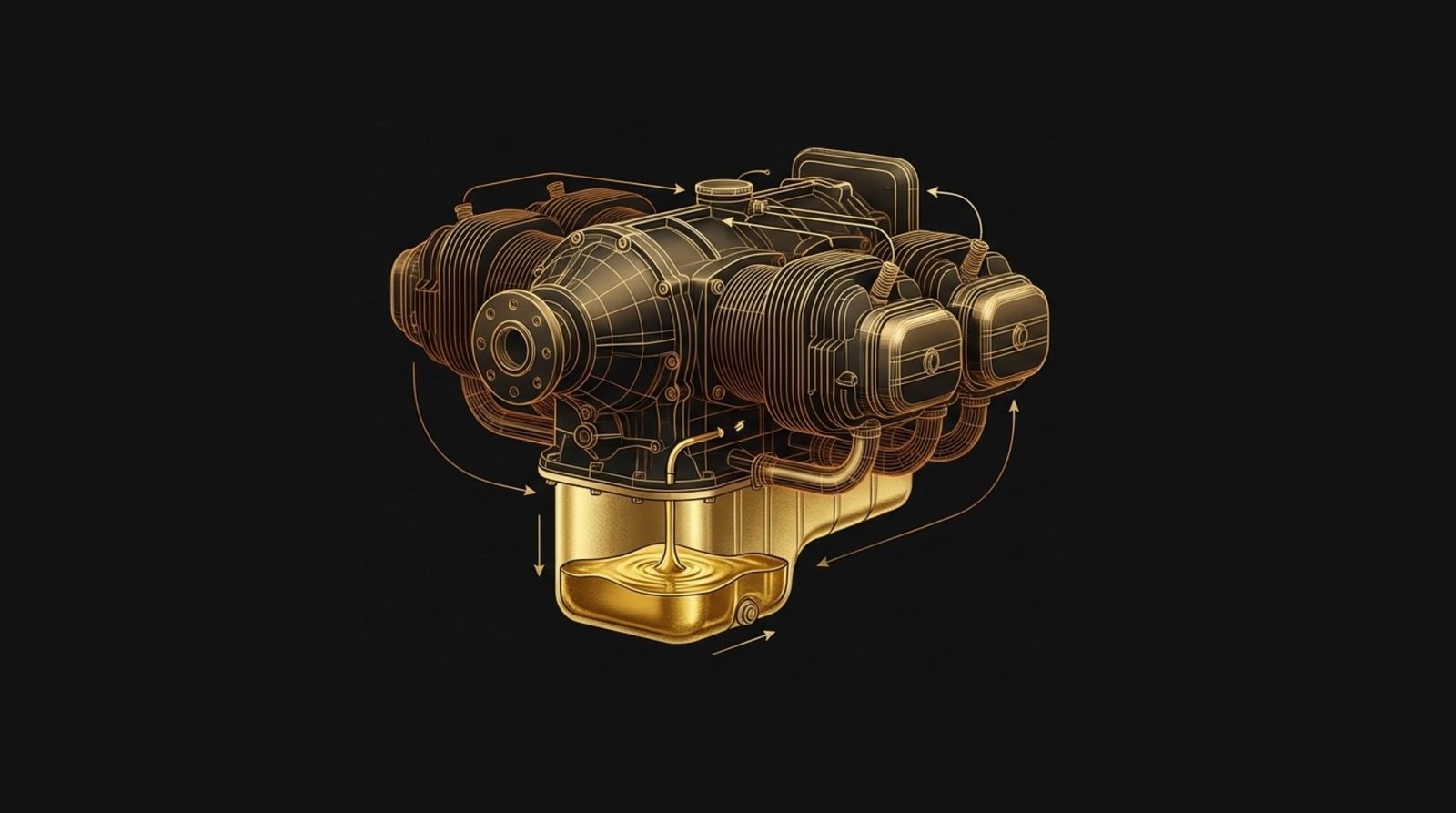
The Wet Sump system is the standard for most light, non-aerobatic aircraft, like the Cessna 172. In this configuration, the oil supply is stored in an integral pan (the sump) attached directly to the base of the engine crankcase.
The Operational Cycle
- Suction side: Oil is drawn from the sump through a suction filter (a coarse mesh strainer) to prevent large contaminants from damaging the pump.
- Pressure side: An internal, engine-driven pump pressurizes the oil.
- Filtration and Cooling: The oil passes through a pressure filter to remove fine particles and then through an oil cooler (or a bypass valve if the oil is still cold).
- Distribution: Oil is sent to the bearings and moving parts—often assisted by “splash and spray” lubrication—before gravity pulls it back down into the sump to restart the cycle.
Advantages and Disadvantages
- Advantages: Exceptional simplicity, fewer parts, and no external lines to develop leaks. It is the most cost-effective solution for general aviation.
- Disadvantages: Limited capacity, more difficult temperature control (as oil is stored in the hot engine casing), and a high risk of oil starvation during aerobatic maneuvers or inverted flight.
4. The Dry Sump System: Performance Under Pressure
The Dry Sump system is the “end-all, be-all” for high-performance and turbine engines. Here, the oil is stored in a separate, external reservoir, leaving the engine crankcase effectively “dry.”
The Engineering Logic of the Two-Stage Pump
A dry sump system requires a more complex arrangement consisting of a Pressure Pump and a Scavenge Pump.
- The Scavenge Pump: Its job is to return oil from the engine sumps to the external tank. As an engineer, I design these with “excess capacity”—often double the capacity of the pressure pump. This is because the scavenge pump must handle aerated oil and blow-by gases. When high-speed engine parts whip oil into a froth (the “milkshake” or hurricane effect), the scavenge pump must be powerful enough to clear this aerated volume and keep the sumps from flooding.
Key Advantages
- G-Load Tolerance: Remote tanks are typically tall and narrow, ensuring the pump outlet is always submerged in oil regardless of the aircraft’s attitude.
- Increased Capacity: Allows for much larger volumes of oil, providing better resistance to heat saturation.
- Lower Center of Gravity: By eliminating the deep internal oil pan, the engine can be mounted lower in the airframe, aiding in aerodynamic design and stability.
5. Component Deep Dive: Special Features of Dry Sump Tanks
Remote oil tanks are sophisticated pieces of hardware. They aren’t just buckets; they are engineered tools for fluid management:
- The “Hot Pot” (or Hopper Tank): This internal cylinder restricts oil circulation during cold starts. By only circulating the oil inside the hot pot initially, the engine warms up faster. As the oil thins, it passes through small ports into the main tank, progressively bringing the full volume into circulation.
- Baffles and De-aerators: Internal baffles prevent “sloshing,” while de-aerator plates separate air bubbles from the returning scavenge oil to prevent frothing.
- Anti-Siphon System vs. Check Valve: These are two different mechanisms. An anti-siphon system prevents the tank from draining through the supply nozzles via a siphoning effect after shutdown. A check valve (or non-return valve) is a spring-loaded device that prevents gravity-fed oil from seeping through pump clearances into the engine when it’s not running.
In dry sump or radial engines, if a check valve fails, oil can pool in the lower cylinders—a condition known as “Over-Oiling.” If you attempt to start an engine in this state, the incompressible oil will cause a Liquid Lock, potentially bending connecting rods or shattering the crankcase. Always pull the prop through by hand if the aircraft has been sitting.
6. Comparison Table: Wet Sump vs. Dry Sump
| Criterion | Wet Sump System | Dry Sump System |
| Storage Location | Integral pan at base of crankcase | Separate, external reservoir tank |
| Pump Configuration | Single internal pressure pump | Pressure + Scavenge pumps (parallel) |
| Typical Application | Light trainers (Cessna 172) | Aerobatic, High-Performance, Turbines |
| Cost / Complexity | Low; minimal hoses/parts | High; complex lines and extra pumps |
| G-Load Tolerance | Poor; high starvation risk | Excellent; consistent flow in all attitudes |
| Weight | Lighter and compact | Heavier due to external tank and lines |
| Center of Gravity | Higher (requires deep oil pan) | Lower (allows for shallow engine profile) |
7. Technical Considerations: Viscosity and Monitoring
Viscosity Index (VI)
Viscosity is the oil’s resistance to flow. As an engineer, I focus on the Viscosity Index. A high VI means the oil has a small change in viscosity over a wide temperature range. This is critical for aviation; it allows for rapid cranking and prompt circulation during cold starts while maintaining a strong lubricant film at operating temperatures (which can exceed 250°C in jet oils).
The Pump Misconception
As a flight instructor, I hear this constantly: “The pump makes the pressure.” No. As the saying goes in the shop, “The pump is just turning and burning; it’s a fluid mover.” The pump moves the oil; the pressure is created by the downstream resistance to that flow within the engine’s bearings and restricted passages.
Monitoring the “Green Arc”
Pilots must monitor both Oil Pressure and Oil Temperature gauges.
- High Temperature + Low Pressure: This is an immediate precursor to structural failure. If you see this, the oil has thinned too much to maintain a film, or you have a major leak.
- Pre-flight: Verify levels as specified in the Airplane Flight Manual (AFM). Ensure you are using the correct SAE grade for the ambient temperature; using the wrong weight can lead to inadequate lubrication or pump cavitation.
8. Conclusion: Choosing the Right System for the Mission
There is no “best” system—only the right system for the mission. For the economy and simplicity of a weekend flyer, the wet sump is an elegant solution. But for the pilot pushing an airframe through high G-loads or the engineer overseeing a multi-million dollar turbine, the dry sump is a non-negotiable requirement.
Engine longevity depends on your vigilance. Use your “detective tools”: inspect Master Chip Detectors and scavenge filters for metallic debris, monitor your gauges religiously, and never skip an oil change. Treat your engine’s lifeblood with respect, and it will keep you in the air.