Introduction:
Say the word “stall” on an airplane, and you’ll likely see a wave of anxiety ripple through the cabin. For most people, the term conjures the visceral image of a car engine sputtering to a stop, leaving the vehicle powerless and coasting to the side of the road. It’s a common and understandable fear, but when it comes to aviation, it’s based on a fundamental misconception.
An aircraft stall has nothing to do with the engine. As instructor Eric from AeroGuard Flight Training Center explains, an aircraft stall is fundamentally different. It refers to an “airfoil stall,” meaning the wing itself has stopped producing enough lift to support the aircraft’s weight. It is a purely aerodynamic event—a predictable and trainable situation involving the wings, not a sudden mechanical failure. It’s about airflow, angles, and aerodynamics.
Much of what the public, and even some novice pilots, believe about stalls is shaped more by Hollywood than by physics. This article will reveal five of the most surprising and counter-intuitive truths about this critical aspect of flight, transforming your understanding from one of fear to one of informed respect for the science of aviation.
1. It’s Not the Engine, It’s the Wing
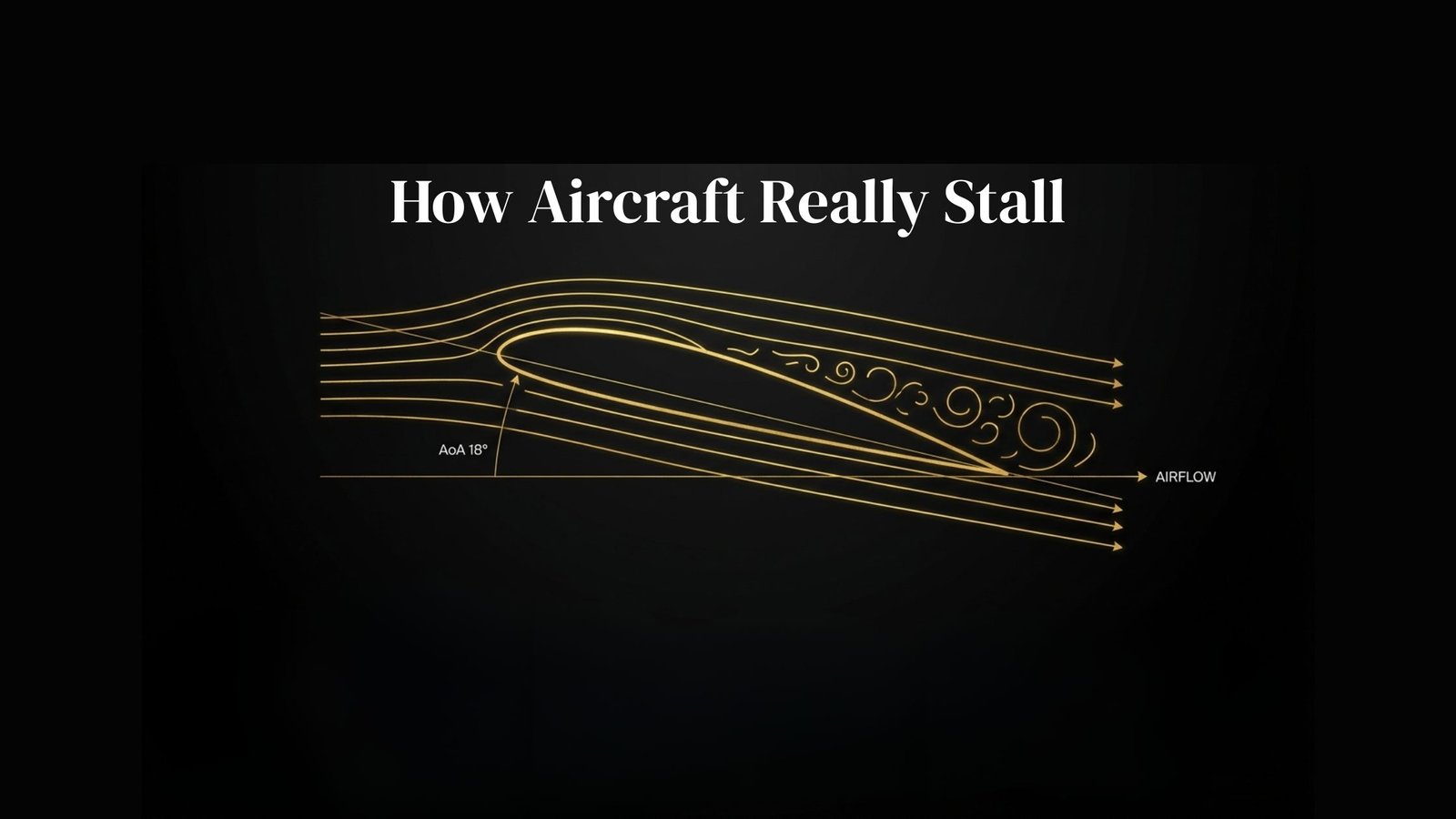
The most critical distinction to make is between a wing stall and an engine stall. They are two completely separate phenomena. A wing stall is defined as a “rapid loss of lift that is caused by the disruption of airflow over the wings.” This happens when the air can no longer flow smoothly over the wing’s curved surface, a condition known as “boundary layer separation.” When this separation becomes significant, the wing can no longer generate sufficient lift.
An engine stall, on the other hand, is a disruption of airflow inside the compressor stages of a jet engine. This can be caused by foreign object damage, ice, or operating the engine outside its design limits. An aircraft can be in a perfect glide with the engine at idle and still experience a wing stall.
Ultimately, the distinction is simple but vital: A wing stall is an aerodynamic event caused by exceeding a critical angle, leading to a loss of lift. An engine stall is a mechanical event within the engine’s compressor, leading to a loss of thrust. Mastering this difference is the first step on any pilot’s journey.
2. You Can Stall at Any Speed, High or Low
One of the most persistent myths in aviation is that stalls only happen when an airplane is flying too slowly. While it’s true that stalls are often practiced and encountered at low speeds, an aircraft can stall at any airspeed. This is because a stall is not determined by speed, but by one critical factor: the angle of attack.
The angle of attack is the angle between the wing’s chord line (an imaginary line from its leading edge to its trailing edge) and the relative wind (the direction of the air flowing over the wing). Every aircraft has a specific “critical angle of attack,” typically between 15 and 20 degrees. If the pilot pulls the nose up and exceeds this angle, the airflow will separate from the wing surface, and the wing will stall—regardless of how fast the plane is moving.
This can lead to a phenomenon known as an “accelerated stall.” Imagine a pilot in a high-speed maneuver, like a steep, aggressive turn. The pilot pulls back hard, feeling the G-forces of a high-performance turn like a Blue Angel… and suddenly the stall warning horn blares. The plane has stalled at a very high speed because the aggressive pull exceeded the critical angle of attack. This is an “accelerated stall,” proving that it’s all about the angle, not the speed.
To add another layer of nuance, consider stalling at high altitude. Because the air is thinner, an airplane has to move faster to generate the same amount of lift. While the indicated airspeed shown to the pilot for a stall remains the same, the aircraft’s true airspeed through the thinner air is significantly higher. It’s yet another example of how speed is a relative, and often misleading, factor in the aerodynamics of a stall.
3. The ‘Big Lie’ About Ailerons and Stalls
For decades, a common instruction given to student pilots has been, “do not use ailerons during a power on stall.” The theory behind this warning is that using an aileron (the control surface on the wingtip) to level the wings could be dangerous. Lowering an aileron increases the angle of attack on that specific wing. If the aircraft is already near a stall, this action could cause that wing to stall first, drop violently, and potentially lead to a spin.
However, this widespread advice overlooks a crucial design feature in most straight-wing aircraft. The truth is that airplanes are intentionally designed to prevent this from happening. The wing root (the part of the wing closest to the fuselage) is designed to stall before the wingtips.
As stated in the Pilot’s Handbook of Aeronautical Knowledge:
“In most straight-wing aircraft, the wing is designed to stall at the wing root first… By having the wing root stall first, aileron effectiveness is maintained at the wingtips, maintaining controllability of the aircraft.”
Engineers achieve this intentionally, often by designing the wing with a slight twist so the root is always at a higher angle of attack than the tip (a feature known as “washout”), or by placing small “stall strips” on the leading edge to disrupt airflow there first. The real danger isn’t using the ailerons; it’s using them in an uncoordinated way. Allowing the aircraft to yaw (swing left or right) while near a stall is the true “recipe for a spin.” The key is to use the ailerons and rudder together to keep the aircraft flying straight and coordinated, maintaining control.
4. A Stall Is Your Plane’s Way of Protecting Itself
While an unintentional stall near the ground is extremely dangerous, the stall itself is not a failure of the aircraft. In fact, it can be viewed as a built-in, natural safety feature designed to protect the airframe from destructive forces.
During high-G maneuvers, the structural load on the wings can become immense. This aerodynamic limit is closely tied to an aircraft’s “maneuvering speed” (Va). Before the G-forces become great enough to bend metal and cause structural failure, the wing will reach its critical angle of attack and stall, releasing that destructive energy.
This concept reframes the stall from a simple failure to a protective mechanism.
“…once you pass your critical angle of attack you will stall before you actually break the plane because then you are trying your aircraft is actually feeling too many g’s.”
This perspective highlights that a stall is a predictable aerodynamic boundary. Pilots train extensively not just to recover from stalls, but to recognize and respect this boundary, using it to fly the aircraft safely within its performance envelope.
5. Some Designs Can Lead to an Unrecoverable ‘Deep Stall’
While most stalls are recoverable by simply lowering the nose, there is a rare and dangerous phenomenon known as a “deep stall” or “super stall.” This condition primarily affects aircraft with specific design characteristics: swept wings and a T-tail (where the horizontal stabilizer sits atop the vertical tail).
In a deep stall, a dangerous chain of events occurs:
- On a swept-wing aircraft, the wingtips tend to stall first. The reduced lift here causes the aircraft’s “center of pressure” to shift forward toward the wing roots.
- This forward shift creates an unstable nose pitch-up moment, pushing the nose even higher and locking the plane deeper into the stall.
- Because the wings are angled backward, the turbulent air, or “wake,” coming off the stalled wingtips flows directly over the tailplane.
- This “low energy turbulent airflow” blankets the elevator (the control surface on the horizontal stabilizer), rendering it ineffective.
With an ineffective elevator, the pilot is unable to push the nose down to counteract the pitch-up moment and reduce the angle of attack. The aircraft can become locked in a stalled state, potentially making the situation unrecoverable. This sobering reality underscores why different aircraft designs have unique flight characteristics and why pilot training is tailored to the specific type of aircraft they fly.
Conclusion:
A stall is not a mysterious or unpredictable failure of the engine. It is a predictable aerodynamic event governed by a single principle: exceeding the critical angle of attack. It’s a fundamental aspect of flight that is about airflow and angles, not mechanical breakdown.
Understanding these truths helps demystify one of the most feared concepts in aviation and fosters a deeper appreciation for the incredible science behind flight and the depth of training pilots undergo. It transforms the stall from a simple boogeyman into a complex and manageable element of aerodynamics.
Now that you know stalls are about airflow and angles, what other common aviation myths are you ready to question?