The history of flight is often told as a solitary, sudden miracle: two brothers on a windswept North Carolina dune in 1903, and then, suddenly, the world had wings. But as an aviation historian, I find the true story far more textured, messy, and global. Our obsession with “firsts” often blinds us to a diverse and technologically experimental era where the conquest of the air was less a sprint and more of a dangerous, collaborative marathon. To understand how we truly took to the skies, we must look beyond the standard curriculum to the dreamers who performed in the full glare of the Parisian press, the 18th-century “aeronauts” who defied social norms, and the ancient inventors who laid the psychological blueprint for flight.
The Public Triumph of the 14-Bis
While the Wright Brothers toiled in relative secrecy, not truly publicizing their confirmed achievements until 1903’s records were validated in 1908, the Brazilian inventor Alberto Santos-Dumont became a global hero through radical transparency. On October 23, 1906, at Bagatelle Field in France, Santos-Dumont did something the Wrights had yet to do: he performed an unassisted, powered flight before a cheering crowd and an official committee from the Aéro-Club de France.
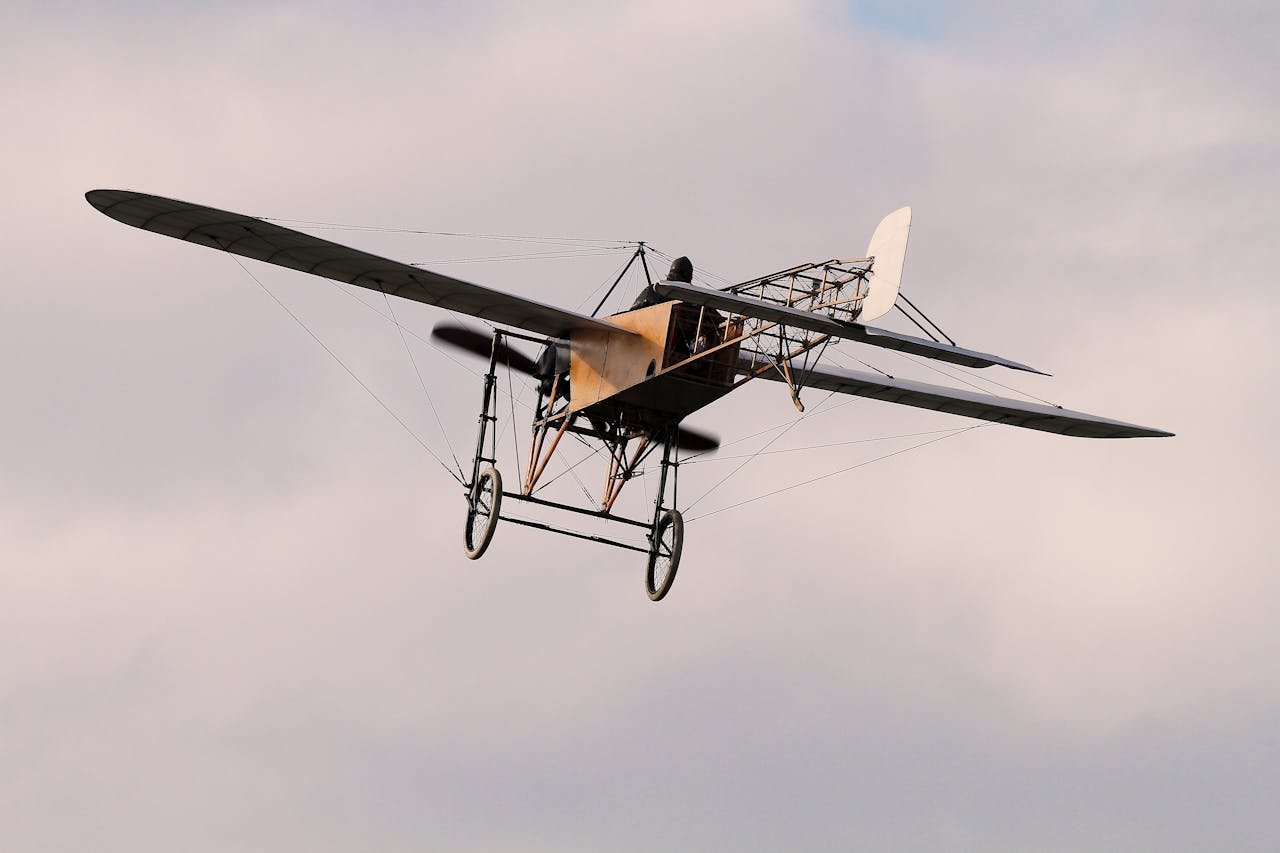
Piloting the “14-Bis”—a fragile-looking contraption of bamboo poles and silk covering—he covered 60 meters to win the Archdeacon Prize. Just weeks later, he set the first official aviation speed record by flying 220 meters in 22 seconds. For the European public, this was the moment the dream became real. As historical records from the time testify:
“The greatest aeronautical authorities recognized that the heavier-than-air flight had been proved.”
Because Santos-Dumont’s aircraft took off from level ground without the aid of launch rails or catapults, many contemporary observers saw him, not the Americans, as the true “conqueror of the air.”
The Psychological Blueprint and a 2,000-Year-Old Balloon
The desire to fly is not a modern phenomenon; it is a primal human ache. Around 1700 BC, the Greek myth of Icarus and Daedalus provided the psychological blueprint for this ambition, framing flight as both a transcendent dream and a terminal danger. This ambition transitioned from myth to math in China around 200 BC with the invention of the “sky lantern.”
Known as the Kongming lantern, these were the world’s first hot-air balloons—lighter-than-air devices initially utilized for military signaling before evolving into cultural icons. The timeline of early experimentation is surprisingly dense:
- 400 BC: Chinese inventors developed the “Bamboo-copter,” a precursor to the helicopter that used feathers to generate lift.
- c. 1010: A monk named Eilmer of Malmesbury constructed a wooden glider and launched himself from a bell tower, successfully gliding 200 meters before a hard landing broke his legs.
These were not mere curiosities; they were the essential, incremental steps of a species refusing to be grounded.
The 18th-Century Aeronauts: Lighter-than-Air Pioneers
Aviation is frequently mischaracterized as an exclusively male pursuit until the mid-20th century. In reality, women were commanding the skies more than a century before the first internal combustion engine sputtered to life. These “aeronauts” operated lighter-than-air balloons with a level of professionalism and courage that helped establish the very concept of “air service.”
In 1784, Marie Élisabeth Thible became the first woman to ascend in a hot-air balloon. She was followed by the formidable Jeanne Labrosse, who in 1798 became the first woman to pilot a balloon solo. Labrosse didn’t stop at piloting; in 1799, she became the first woman to perform a parachute jump, leaping from a balloon to the gasps of the Parisian public. By 1810, the field had become so established that Sophie Blanchard was named Napoleon’s “chief of air service.” These women were not mere passengers; they were flight’s first professional advocates.
The Engineering Paradox of the “Backward Arrow”
Technically, early heavier-than-air flight was a chaotic laboratory of trial and error. Santos-Dumont’s 14-Bis utilized a “canard” configuration, placing the horizontal stabilizer at the front of the aircraft to prevent the nose-down tendencies that had plagued earlier glider pioneers.
The design was a beautiful, unstable paradox. The wings were based on Lawrence Hargrave’s box kites, and the pilot stood upright in a wicker balloon basket. The control system was famously eccentric: to command the ailerons for roll control, Santos-Dumont used cables hooked directly to the shoulders of his coat. To turn the aircraft, he had to physically lean or shrug his shoulders—a visceral, bodily connection to the machine. Despite upgrading from a 24 HP to a 50 HP Antoinette engine, the 14-Bis was an aerodynamic nightmare. It was marginally stable in pitch but fundamentally unstable in yaw. Santos-Dumont himself captured the frustration of the design:
“…it was like trying to shoot an arrow with its feathers in the front.”
The Open-Source Humanitarian of the Skies
Perhaps the most surprising truth about the dawn of aviation is that one of its greatest pioneers was a dedicated “open-source” philosopher. Alberto Santos-Dumont viewed aviation as a gift to humanity rather than a corporate asset. A man of immense character and a few quirks—such as skipping the number 8 in his designs due to a deep-seated superstition—he refused to patent any of his inventions.
When he built the “Demoiselle” (No. 19), one of the world’s first true ultralight aircraft, he shared the plans freely. This allowed companies like Clément-Bayard to mass-produce the design, sparking a rapid dissemination of technology that a patent war would have stifled. His humanitarianism was as famous as his flight; after winning the Deutsch de La Meurthe prize for flying his dirigible around the Eiffel Tower, he gave half the money to his assistants and the other half to the poor of Paris.
Santos-Dumont even envisioned flight as a daily utility. He used his “Dirigible No. 9,” which he called his “flying chariot,” as a personal transport, famously landing the small airship outside his favorite Parisian cafes to run errands, bringing the future of flight to the very doorsteps of the public.
——————————————————————————–
The conquest of the air was never a clean, linear progression. It was a dangerous, often terminal experiment. The 14-Bis, for all its glory, was severely damaged during a trial in 1907 and never repaired—a reminder of how thin the line was between a historic record and a heap of bamboo and silk.
If the Wright Brothers had never flown at Kitty Hawk, our history books would likely crown the public, unassisted demonstrations in France as the definitive start of the age of flight. Ultimately, the history of aviation belongs not to a single pair of brothers, but to a global collective of aeronauts, engineers, and dreamers who were willing to risk everything for a few seconds of grace above the earth. Would our perception of the “race for the skies” change if we valued public proof over private milestones? Perhaps the winner isn’t the one who flies first, but the one who shows the world how it’s done.
Sources:
- https://en.wikipedia.org/w/index.php?title=Claims_to_the_first_airplane_flight&oldid=1332315453
- https://en.wikipedia.org/w/index.php?title=Timeline_of_aviation_before_the_18th_century&oldid=1326893322
- https://en.wikipedia.org/w/index.php?title=Timeline_of_women_in_aviation&oldid=1327007629
- https://en.wikipedia.org/w/index.php?title=Wright_Flyer&oldid=1330350701
- afa.org (associated with Air & Space Forces Magazine)
- Copyright.gov (listed within the Library of Congress collection papers)
- Congress.gov (listed within the Library of Congress collection papers)
- USA.gov (listed within the Library of Congress collection papers)