Introduction
For most passengers, a glance into an airplane cockpit reveals an intimidating wall of dials, gauges, and screens. It looks like a secret language, a complex code understood only by the pilots in their seats. But behind this apparent complexity lie some surprisingly simple—and often counter-intuitive—principles that have guided aviators for decades.
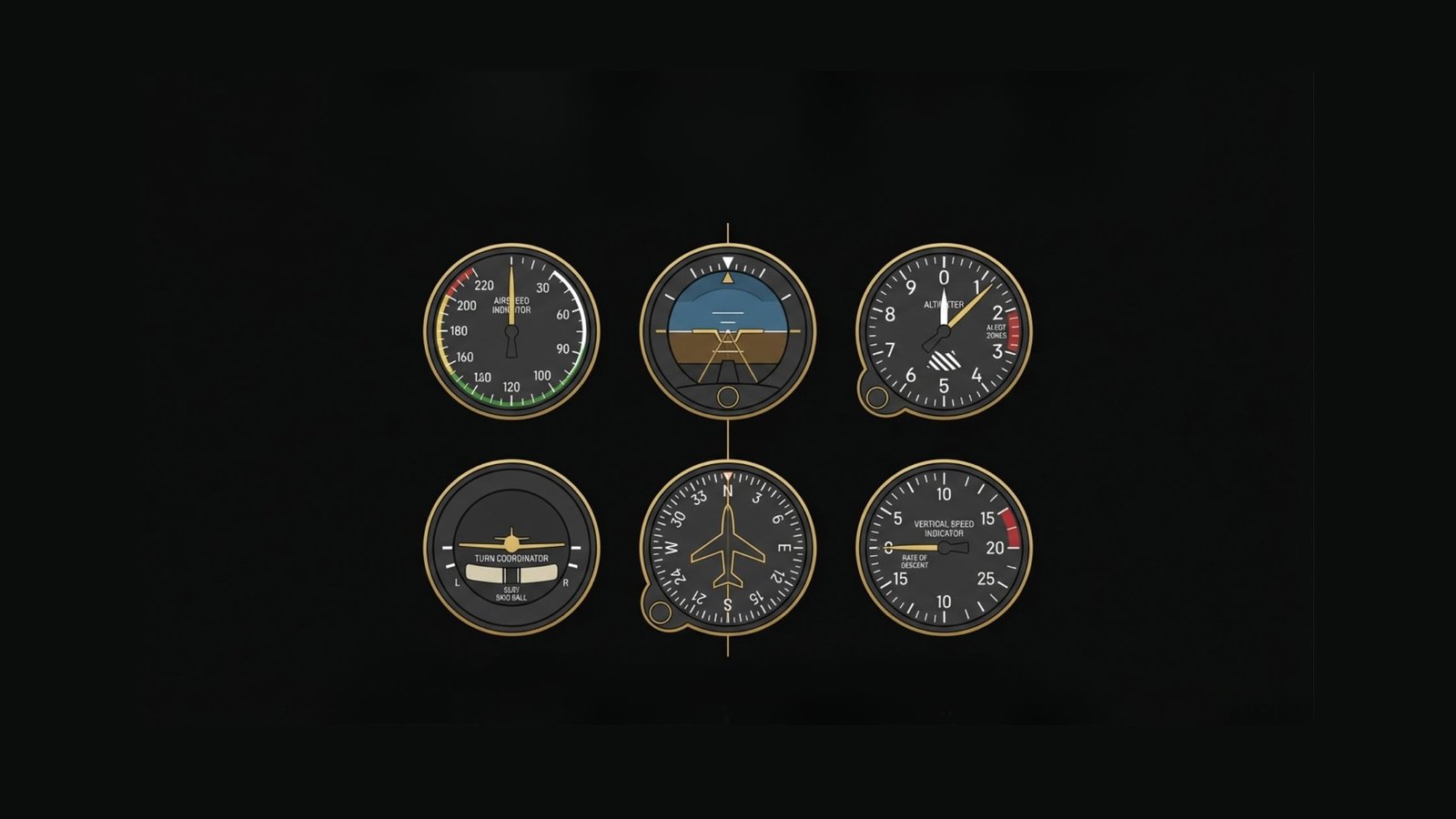
This intricate display is built around a core set of just six primary instruments. Known to pilots as the “six-pack,” these gauges provide the most critical information about the aircraft’s speed, altitude, and orientation. While modern “glass cockpits” with their dazzling digital screens get all the attention, the real genius of flight instrumentation lies in the fundamental physics that make the classic dials work. This article will pull back the curtain on five of the most fascinating truths about the instruments pilots use to fly, revealing that things in the cockpit aren’t always what they seem.
——————————————————————————–
1. An Airplane’s Speed Isn’t Just One Number—It’s Four
While your car has a single speedometer showing how fast you’re moving over the road, an airplane’s speed is a far more complex concept. Pilots must manage several different types of “speed,” each one critically important for a different reason, from safely getting off the ground to navigating accurately across the country. To keep it all straight, flight instructors often use the mnemonic “iced tea” (I-C-T) followed by G. The four main types a pilot tracks are:
- Indicated Airspeed (IAS): This is the raw number the pilot sees on the airspeed indicator. It measures the pressure of the air hitting the aircraft, which is essential for “flying the airplane.” Key maneuvers like takeoffs, turns, and landings are all performed by referencing IAS because it directly relates to the amount of air flowing over the wings to generate lift.
- Calibrated Airspeed (CAS): This is the indicated airspeed corrected for known errors in the instrument itself or its installation on the aircraft. It’s a necessary intermediate step to get a more accurate number.
- True Airspeed (TAS): This is the actual speed of the aircraft as it moves through the mass of air around it. It is calculated by taking calibrated airspeed and correcting it for non-standard air pressure and temperature, which change with altitude.
- Ground Speed (GS): This is the airplane’s actual speed over the surface of the earth. It is the plane’s true airspeed with the effect of wind factored in. A tailwind increases ground speed, getting you to your destination faster, while a headwind decreases it.
This distinction is the daily language of a pilot. They fly the wing on Indicated, but plan the journey and the fuel on Ground Speed—two different numbers for two critical, interlocking tasks: survival and arrival.
——————————————————————————–
2. A Pilot’s Altimeter Can Lie
In aviation, there is a classic and life-saving mnemonic: “High to Low, Look Out Below.” This simple phrase warns pilots of a dangerous illusion created by the altimeter, the instrument that shows the aircraft’s altitude above sea level.
The altimeter is essentially a sensitive barometer. It works by measuring static air pressure, which decreases predictably as an aircraft climbs. However, this system relies on a correct local pressure setting, which a pilot gets from air traffic control and dials into the instrument. If a pilot flies from an area of higher atmospheric pressure into an area of lower pressure (for example, toward an approaching storm) without updating that setting, the altimeter will lie. It will incorrectly report that the aircraft is higher than it actually is.
This creates an incredibly dangerous situation where the pilot believes they have plenty of clearance over mountains or obstacles, when in reality they could be descending much closer to the ground than they think.
[I]t’s giving you… a false sense of security that’s dangerous. [High] to low, Look Out Below.
This is why constant vigilance is required. Pilots must frequently obtain updated altimeter settings from ground stations to ensure that what their instrument is telling them is the truth.
——————————————————————————–
3. The Nose Can Point Up While the Plane Goes Down
It’s one of the most counter-intuitive realities of flight: an aircraft can have its nose pointed toward the sky while it is actively descending toward the ground. This isn’t an emergency or a stall; it’s a normal aerodynamic state that demonstrates how flying is about managing energy, not just pointing the nose.
This happens when a pilot significantly reduces engine power, such as when preparing for landing. With less thrust pushing the aircraft forward, airspeed begins to decrease. To maintain just enough airspeed to keep flying, the pilot must raise the nose. The result is a nose-high attitude, but because the engine isn’t producing enough power to climb, the aircraft loses lift and begins a controlled descent. The altimeter will clearly show a loss of altitude even as the nose is aimed above the horizon.
[W]hat now happens is as I try and put it at 60 knots and I pull up a little bit on the nose the flight speed is dropping even though I’ve got nose high attitude we’re descending if you look at our altimeter we’re actually going down not up even though our nose is high we’re going down that’s because we’ve reduced power.
This phenomenon is a perfect illustration that flight is a delicate balance of forces. An aircraft’s path through the sky is determined by the interplay of lift, weight, thrust, and drag—not simply by where the nose is pointing.
——————————————————————————–
4. Pilots Constantly Scan Their Instruments in a Precise Pattern
When flying in clouds, fog, or at night without a visible horizon—a condition known as Instrument Meteorological Conditions (IMC)—a pilot cannot rely on their sense of balance to know which way is up. They must depend entirely on their instruments. But they don’t just stare at the gauges; they employ a highly disciplined technique called an “instrument cross check” or scan.
One of the most effective techniques is the “hub and spoke method.” The attitude indicator, which shows the aircraft’s orientation relative to the horizon, acts as the central “hub.” The pilot’s eyes continuously move from this central instrument to one of the “spokes”—like the airspeed indicator, altimeter, or heading indicator—and then immediately back to the hub. Attitude, to airspeed, back to attitude. Attitude, to altitude, back to attitude. And so on, in a constant, rhythmic loop.
This systematic scan allows the pilot to build a complete and accurate mental picture of the aircraft’s performance without fixating on any single instrument. It’s a skill that requires immense practice and is absolutely critical for safety.
[W]e’re trying to control the airplane with extreme precision because we may not be able to see outside when we’re flying in the weather and being at the wrong altitude or in the wrong location can mean the difference in running into a tower or terrain.
——————————————————————————–
5. The Gauges are Powered by Simple Air and Spinning Tops
In an age of sophisticated glass cockpits and fly-by-wire systems, it’s amazing to realize that the “basic six” instruments are powered by two elegantly simple and reliable systems: air pressure and gyroscopes.
First is the Pitot-Static System. Imagine holding your hand out the window of a moving car, palm facing forward. Your hand feels two distinct pressures: the ever-present static pressure of the atmosphere and the dynamic pressure from the force of the wind. The combination of these two is “total pressure,” and this ingenious system measures those pressures precisely. A static port on the side of the fuselage measures ambient air pressure, while a forward-facing pitot tube measures total pressure. By comparing these, the system powers the Airspeed Indicator, Altimeter, and Vertical Speed Indicator.
Second is the Gyroscopic System. This system powers the Attitude Indicator, Heading Indicator, and Turn Coordinator. It uses gyroscopes—heavy discs that spin at incredibly high speeds. Due to a principle called “rigidity in space,” these spinning gyros fiercely resist any change to their orientation, just as a spinning top wants to stay upright. The aircraft moves around these stable, spinning gyros, and the instruments translate that relative movement into precise readings of the plane’s attitude and direction. Crucially, these gyros are often powered by two different sources—some by a vacuum system driven by the engine, others by the aircraft’s electrical system. This clever redundancy ensures that even if one power source fails, the pilot retains a set of reliable instruments.
——————————————————————————–
Conclusion
The next time you get a peek inside a cockpit, look past the complexity. See the dials and gauges for what they truly are: windows into a world of fascinating physics, clever engineering, and the hard-won skill required to master the air. They are not just relics of a bygone era but elegant tools that continue to tell pilots the fundamental truths of flight.
So the next time you’re on a flight, peering out at the world sliding by below, remember the elegant dance of physics and skill happening just behind the cockpit door—a mastery of air, pressure, and motion that makes it all possible.