1. Introduction: Why the Airspeed Indicator is Your Most Vital Instrument
In the cockpit “six-pack,” every instrument has a job, but the Airspeed Indicator (ASI) is the undisputed heartbeat of your aircraft. As Mike Thompson often says, you can fly without an altimeter by looking at the trees, and you can navigate without a compass by following a highway or the position of the sun. But you cannot guess your airspeed.
Airspeed is the fundamental force that determines whether your wings produce lift or your aircraft becomes a very expensive brick. For a student pilot, the ASI is your lifeline. Mark my words: understanding this instrument isn’t just about passing your FAA written exam; it’s about having the situational awareness to keep the plane flying when things go south. If you don’t respect the ASI, the laws of physics will eventually catch up with you.
2. The Physics of Airspeed: How the Instrument Works
At its core, the ASI is a differential pressure gauge. It doesn’t actually “measure” speed like a speedometer in a car; it measures the difference between two types of air pressure and translates that into knots or miles per hour.
The Internal Mechanics
Inside the instrument case, there is a flexible component called a diaphragm. To understand how the ASI works, you must understand the physical “bridge” between the pitot-static system and the instrument itself:
- The Diaphragm: This is connected directly to the pitot tube. It receives “Total Pressure” (also called Ram or Impact air).
- The Instrument Case: The rest of the sealed case is vented to the static port. This provides the “Static Pressure” (the ambient atmospheric pressure).
As you fly faster, more ram air enters the pitot tube, causing the diaphragm to expand like a balloon. Because the case is filled with static air, the instrument effectively “subtracts” the static pressure from the total pressure. What remains is Dynamic Pressure, which is directly proportional to your velocity.
To isolate the velocity (V), the instrument uses an “imaginary formula”: V = (D + S) – S (Where V is Velocity/True Airspeed, D is Dynamic Pressure, and S is Static Pressure) By cancelling out the static pressure found in both the pitot and static systems, the instrument leaves only the dynamic pressure to drive the mechanical linkages and move the needle.
Hardware Variations
During your pre-flight, look closely at your hardware. Most trainers use a standard pitot tube and a separate static port—a small circular disc, usually surrounded by four screws with a hole in the center, located on the side of the fuselage. However, if you’re in a Piper, you’ll see a blade-style pitot tube (the “inverted shark fin”) under the wing. This blade often combines functions, with a hole in the front for ram air and holes on the bottom or back for drainage and static equalization.
3. Decoding the Dial: Color-Coded Markings and V-Speeds
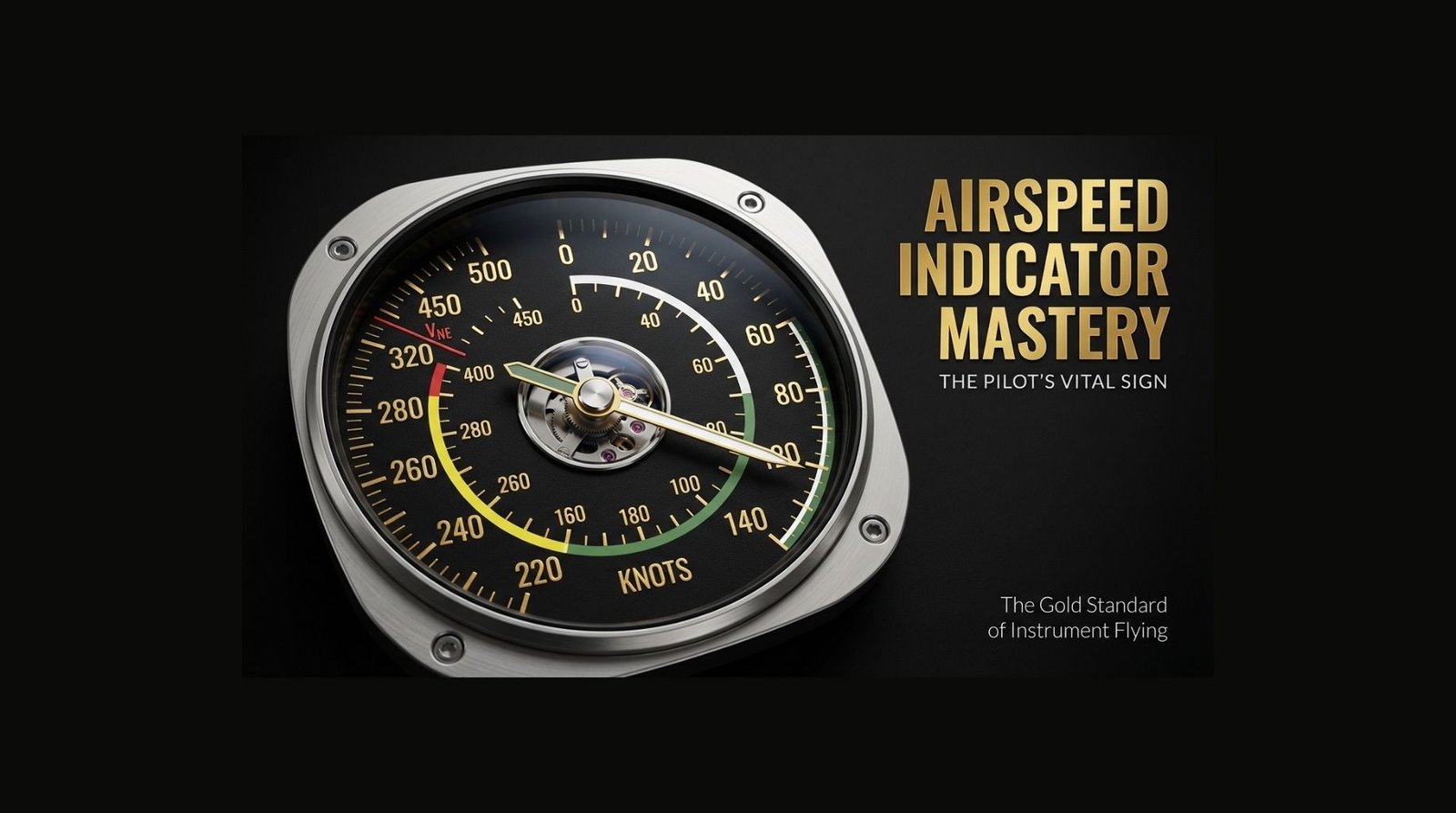
The face of the ASI is a roadmap of your aircraft’s structural integrity. You need to know these ranges like the back of your hand for your checkride.
| Marking | Range / V-Speed | Definition | Safety Meaning |
| White Arc | VS0 to VFE | Flap Operating Range | Start of the arc is stall speed in landing configuration; end is max speed for flaps. |
| Green Arc | VS1 to VNO | Normal Operating Range | Start is stall speed “clean”; end is Maximum Structural Cruising Speed. |
| Yellow Arc | VNO to VNE | Caution Range | Only fly in this range in smooth air; do not make abrupt control movements. |
| Red Line | VNE | Never Exceed Speed | Structural failure (like losing a wing) can occur above this speed. |
To keep your stall speeds straight, remember the “Stuff” rule:
- VS0: Stall with Stuff Out (Landing configuration: Gear and flaps down).
- VS1: Stall with Stuff In (Clean configuration: Gear and flaps up).
The Invisible Killer: Maneuvering Speed (VA)
One speed you won’t find on the dial is VA (Maneuvering Speed). This is the speed at which the airplane will stall before it breaks if you hit heavy turbulence or make a sudden control input. Above VA, you risk structural failure before a stall can “relieve” the pressure on the airframe. Because VA changes based on weight, it isn’t marked on the ASI—check your Pilot’s Operating Handbook (POH).
4. The “Five Speeds” Hierarchy: From Indicated to Ground
As you climb, the “raw” number on the dial starts to lie to you. You must understand the hierarchy of speeds used in flight planning and navigation:
- Indicated Airspeed (IAS): The uncorrected reading you see on the dial. This is what you fly by for stalls and landings.
- Calibrated Airspeed (CAS): IAS corrected for instrument and position errors (how the air flows around the pitot tube at different angles of attack).
- Equivalent Airspeed (EAS): CAS corrected for air compressibility. This only matters if you’re flying a “blow-torch” (jet) over 300 knots.
- True Airspeed (TAS): CAS corrected for non-standard temperature and altitude.
- Ground Speed (GS): TAS corrected for wind. This is what determines when you’ll actually arrive at your destination.
As you climb, the air becomes less dense. There are literally fewer air molecules entering the pitot tube to expand the diaphragm. Therefore, your IAS will look lower than your actual speed through the air. Rule of Thumb: Your TAS increases by approximately 2% for every 1,000 feet of altitude gain.
5. Systems Failure: Identifying Blockages in Flight
When the pitot-static system fails, the ASI can become the most confusing instrument in the cockpit. You need to recognize these three states instantly:
- Pitot Tube Blocked (Drain Hole Open): If the front hole is clogged (ice or bugs) but the drain is clear, the ram air pressure simply bleeds out the back. The needle will drop to zero.
- Pitot Tube and Drain Hole Blocked: This is the dangerous one. Pressure is now trapped inside the diaphragm. The ASI will freeze, then begin to act like an altimeter. As you climb, the outside static pressure in the instrument case drops, allowing the trapped air in the diaphragm to expand. You’ll see an erroneous increase in airspeed as you climb—a deadly trap during a go-around.
- Static Port Blocked: If the static port clogs, the ASI will exhibit a “reverse altimeter” effect. It will read lower than actual speed in a climb and higher in a descent. Crucial Detail: The severity of this error depends on the altitude where the blockage occurred, as the instrument is comparing current ram air to “trapped” static air from that specific altitude.
6. Practical Flight Skills: The “Inverse Relationship”
Think of the ASI as a secondary Vertical Speed Indicator. Just like driving a car, your aircraft reacts to the “hills” of the sky. If your power is constant and your speed is increasing, you are pointed down (trading altitude for speed). If your speed is decreasing, you are pointed up.
This Inverse Relationship is vital for recovering from “unusual attitudes.” If your instructor covers your primary flight instruments, the ASI can tell you exactly what the nose is doing. If the needle is moving toward the red line, get that nose up!
7. Conclusion: The Path to Instrument Mastery
The Airspeed Indicator is a mechanical marvel that turns invisible air pressure into life-saving data. While modern glass cockpits do the math for you, a professional pilot must understand the “why” behind the needle. Knowing how pressure affects your diaphragm—and how blockages can turn your ASI into a liar—is what separates a “passenger in the left seat” from a true Pilot-in-Command.
Now that you’ve mastered the heartbeat of the aircraft, it’s time to look at the rest of the “six-pack.” Keep your eyes on the V-speeds, stay in the green, and keep learning. Next stop: the Altimeter.