
1. Introduction: The Lifeblood of Modern Flight
In the world of aviation, the electrical system is much more than a collection of wires; it is a self-contained network designed to generate, transmit, distribute, utilize, and store the energy that keeps a flight safe and functional. Think of it as the aircraft’s nervous system, providing the vital impulses required for engine starters, interior and exterior lighting, flight instruments, navigation suites, and communication radios.
While these systems are essential for modern flight, as an educator, I always remind students that simplicity is the ultimate redundancy. Some extremely basic designs, like certain single-engine piston aircraft, forgo an electrical system entirely. These “purist” machines rely on magneto ignition systems—which are self-powering—and gravity-fed fuel systems. They are often started via “hand-propping” or a manual crank. However, for the rest of the flying world, a deep understanding of electrical architecture is non-negotiable for safety.
2. The Anatomy of Power: Core Components and Their Roles
The complexity of an electrical system scales with the aircraft, ranging from a basic DC setup in a trainer to the sophisticated multi-voltage networks found in wide-body jets. Below are the foundational components you will encounter.
| Component Name | Primary Function | Did You Know? |
| Alternators / Generators | The primary source of power during flight; these also replenish the battery. | Commercial AC systems typically operate at 115-120V and 400Hz, a high frequency that allows for smaller, lighter components. |
| Batteries | Provides power for engine startup and serves as the ultimate emergency backup. | Cold weather severely reduces battery capacity. While lead-acid and NiCad are traditional, lithium batteries are becoming more and more common. |
| Busses | Acts as a central distribution hub to provide power to multiple individual systems. | A bus is essentially a “power strip.” If you lose a bus, every component plugged into it goes dark. |
| Circuit Breakers / Fuses | Protects wiring from heat and overloads by interrupting the circuit. | Breakers are resettable in flight (with restrictions), whereas a blown fuse is a permanent “open” until replaced on the ground. |
| Voltage Regulators | Stabilizes the alternator output to ensure a steady, safe voltage level. | They prevent “surges” and manage the rate at which the alternator charges the battery to avoid damage. |
| Ammeters / Load Meters | Visual instruments that allow the pilot to monitor system health and balance. | An ammeter shows the battery’s relationship to the system (charging vs. discharging), while a load meter shows the total alternator demand. |
3. Visualizing the Flow: The Plumbing Analogy
To demystify how electricity moves, I often use the “plumbing” analogy. If you can visualize water moving through a hose, you can understand a circuit.
- Voltage: This is your Pressure. It is the force pushing the energy through the lines.
- Amperage (Current): This is the Flow. It represents the volume of water (electrons) moving through the system.
- Resistors: Think of these as a Kink in the Hose. They constrict the flow, creating a planned reduction in energy for specific components.
- Diodes: These are One-Way Check Valves. They ensure electricity only flows in the intended direction. For example, a diode in the Ground Service Plug ensures ground power doesn’t flow backward into the battery unrestricted.
- Wires: These are the Hoses. To move a massive amount of “water” (like to an engine starter), you need a “large-diameter hose” (thick, heavy-gauge wire).
- Grounding: This is the Return Path. In an aircraft, the metal airframe itself acts as a massive return pipe. By connecting the negative side of components to the airframe, the circuit is completed back to the battery without needing a second full-length wire for every light or radio.
4. Distribution and Protection: The Role of the Bus and Solenoid
We manage distribution through the Electrical Bus. Following our “power strip” analogy, most aircraft utilize a Main Bus for heavy-draw items like lighting and a dedicated Avionics Bus to protect sensitive navigation and communication equipment.
One of the most critical safety components is the Solenoid (or battery contactor). Why do we use it? In a light aircraft, the battery might be in the tail or the engine compartment. We don’t want to run heavy, high-current “hoses” (thick wires) all the way into the cockpit just to reach a switch. Instead, we use a solenoid—a heavy-duty relay. This allows you to use a “tiny valve” (the Master Switch) to control a “massive flow” of electricity elsewhere in the airframe. When you flip the Master Switch, you send a tiny current to the solenoid, which then magnetically slams shut a heavy-duty connection, powering the entire aircraft.
5. Evolution of Complexity: From Simple GA to Advanced Jets
Aviation electrical systems have evolved from simple “battery-and-alternator” setups to highly redundant, multi-sourced power plants.
- Simple Systems: Common in General Aviation, these typically feature 14V or 28V DC power, a single battery, and a single alternator. They often include a plug for a Ground Power Unit (GPU) to assist with starts without draining the battery.
- Advanced Systems: Commercial jets utilize a complex mix of AC and DC. Primary power is generated as AC and then passed through Transformer Rectifier Units (TRUs) to become DC for specific busses.
- Redundancy: They feature Auxiliary Power Units (APUs) and Ram Air Turbines (RATs) as backup generators.
- The Static Inverter: In a total AC generation failure, a Static Inverter is used to convert DC battery power back into AC, ensuring the Essential AC bus stays powered for critical flight instruments.
6. Pilot Monitoring: Ammeters vs. Load Meters
Monitoring your system is an active process. You must know what your gauges are telling you before a “low voltage” light ever flickers.
The Ammeter shows the performance of the system relative to the battery. A positive reading means the alternator is “feeding” the battery. A negative reading means the battery is “feeding” the system—a clear sign of alternator failure. As an educator, I tell my students: A zero indication on the ammeter is a “steady state”—it tells you the system is perfectly balanced, but it also warrants a closer look at your load meter to ensure the alternator hasn’t actually quit.
The Load Meter displays the total demand (in Amps) placed on the alternator itself. If your load meter shows “40,” your alternator is working to provide 40 Amps. If it shows “0,” your alternator is either switched off or has failed completely, regardless of what the ammeter says.
7. Threats, Defenses, and Emergency Procedures
Electrical systems face four primary threats: Generator Failure, Bus Failure, Component Failure, and Electrical Fires.
Redundancy Layers Modern aircraft are designed with “layers of defense.” If an engine-driven generator fails, the APU, RAT, or cross-side generators provide immediate backup to keep essential systems online.
Circuit Breaker Protocols Breakers are there to prevent fires. If a breaker “pops,” it’s telling you that a circuit is overstressed or overheating.
- You may reset a popped breaker once, provided it is for a non-critical system and there is no smell of smoke.
- If it pops a second time, do not reset it again.
- The Critical Exception: Breakers for fuel pumps should never be reset in flight, as the risk of an internal spark causing an explosion far outweighs the benefit of the pump.
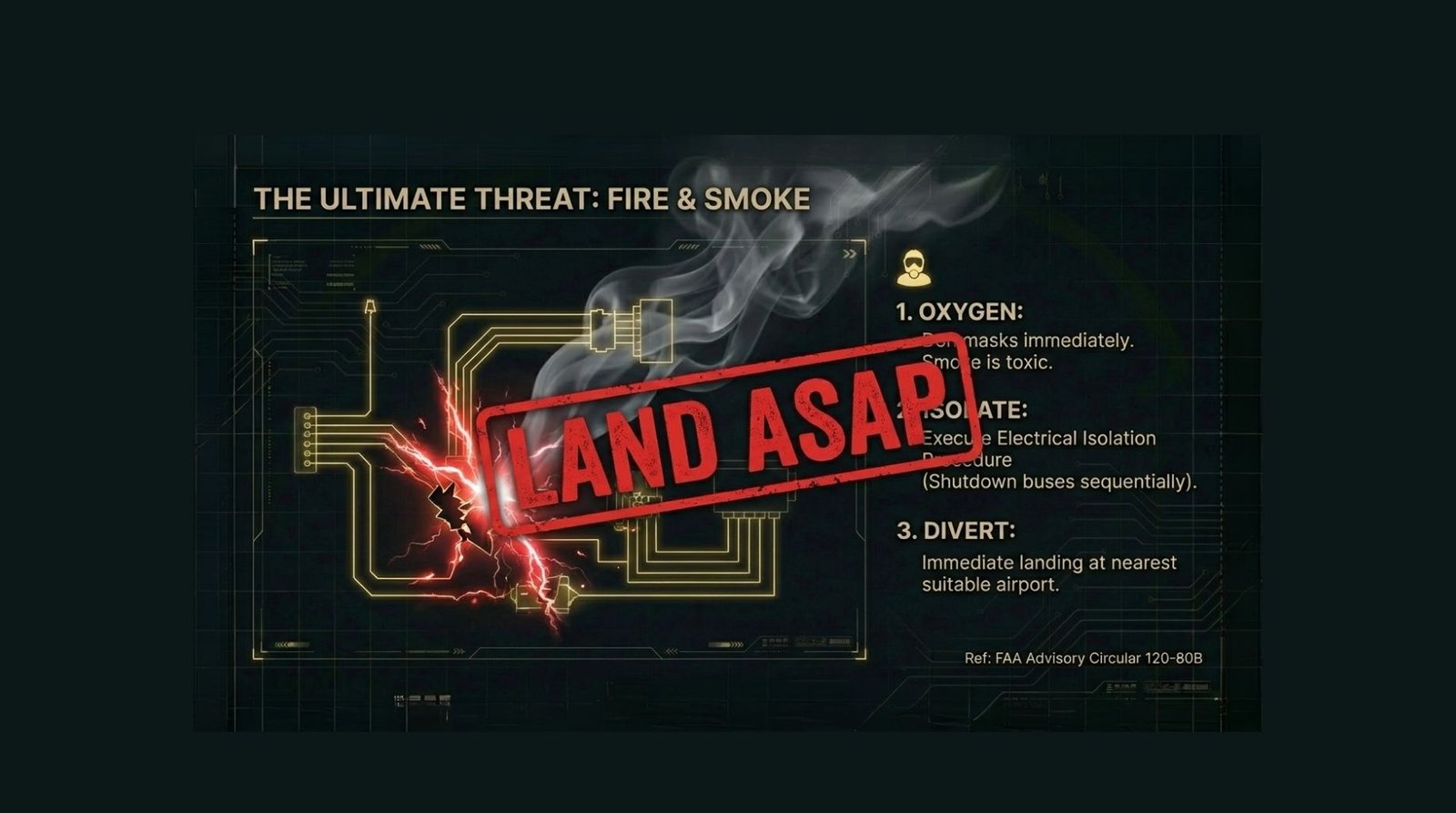
Emergency Isolation If you suspect an electrical fire (smoke or fumes), your priority is isolation. Use the Quick Reference Handbook (QRH) to identify the faulty bus. If smoke persists, the standard protocol is to isolate the system and Land ASAP.
8. Real-World Stakes: Historical Lessons
The following incidents remind us why system awareness is a survival skill:
- Swissair MD11 (1998): An uncontainable in-flight electrical fire led to the total loss of the aircraft and all souls on board.
- British Midland A321 (2010): An electrical malfunction caused the intermittent loss of both pilots’ EFIS displays and an uncommanded attitude change during a night flight.
- British Airways A319 (2009): During a night pushback, an electrical malfunction blanked the EFIS displays and produced electrical fumes, necessitating an emergency shutdown.
- American Airlines B752 (2008): After losing significant electrical functionality, the commander was forced into an emergency diversion. Fearing an overrun due to a loss of braking and steering functionality, he intentionally steered the aircraft off the runway to stop it.
9. Conclusion: The Criticality of System Awareness
Understanding your aircraft’s electrical schematic is not a theoretical exercise—it is a tactical necessity. As a pilot, you are the final manager of these systems. By mastering the relationship between your ammeter and load meter, respecting the limits of your battery (especially in cold weather), and understanding the “return path” of your airframe, you transform from a mere operator into a systems specialist. Awareness and strict adherence to emergency protocols remain our primary safeguards as we power through the skies.