If you want to understand why your engine delivers reliable power or why it might suddenly quit on a warm, humid afternoon, you have to master the carburetor. As a Senior Aviation Maintenance Technician and Flight Instructor, I’ve seen enough “stuck” throttles and rough-running engines to know that a pilot’s lack of technical respect for the induction system is a safety liability. The carburetor is the heart of the engine; it is where fuel and air are metered in precise proportions before they ever reach a cylinder. It is mechanically linked to your throttle, meaning your hand on that lever is directly regulating the mass of the air-fuel charge.
2. The Physics of Carburetion: The Venturi and Metering Force
The operation of a float-type carburetor is governed by the Venturi Principle. Inside the carburetor barrel is a restricted passage known as the venturi. According to Bernoulli’s Principle, as air is drawn through this restriction by the downward stroke of the pistons, its velocity increases while its pressure drops.
This creates the “metering force.” The fuel in the float chamber is under atmospheric pressure, while the discharge nozzle is located in the low-pressure area of the venturi throat. Source data indicates that a pressure differential of approximately 0.5 “Hg is required to raise the fuel from the chamber to the discharge level. Furthermore, per Boyle’s Law, as air pressure drops within the unit, the temperature reduces—frequently by as much as 30°F to 70°F—creating a refrigeration effect that can turn ambient moisture into engine-killing ice.
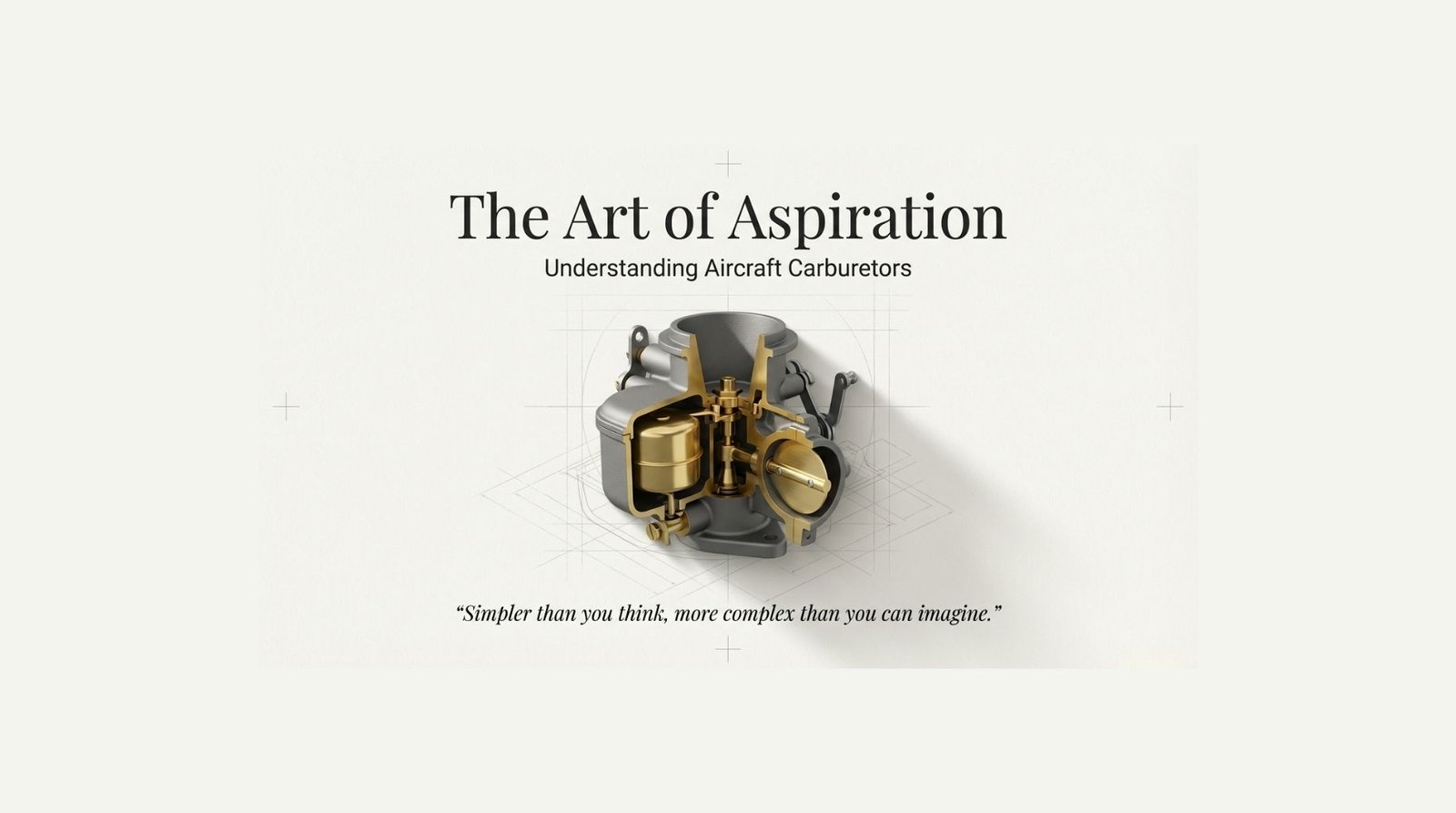
3. Anatomy of a Float-Type Carburetor
A technician looks at a carburetor and sees a reservoir of fuel maintained at a specific level: exactly 1/8″ below the discharge nozzle holes. This precise clearance prevents fuel from leaking out of the nozzle when the engine is not running.
To maintain a consistent mixture at lower speeds, carburetors utilize an Air Bleed system. By introducing air into the fuel nozzle slightly below the fuel level, the system decreases fuel density and destroys the surface tension of the liquid. This allows for better vaporization and more controlled discharge when the pressure differential is low.
| System | Primary Function |
| Main Metering System | Supplies fuel at all speeds above idling; regulated by the venturi pressure drop. |
| Idling System | Provides fuel via an idling jet near the throttle valve edge when air velocity is too low for the main system. |
| Accelerating System | Supplies extra fuel during sudden throttle openings to prevent “stumbling” caused by the slow response rate of the main metering system. |
| Mixture Control System | Prevents the mixture from becoming over-rich at altitude as air density decreases. |
| Idle Cutoff System | Completely stops fuel flow; the only safe way to shut down an engine to prevent accidental “kick-over.” |
| Power Enrichment (Economizer) | A valve that opens at high power (above 60–70%) to provide extra fuel for cooling and prevent detonation. |
The Butterfly Valve (Throttle Valve) is the pilot’s primary control. Positioned on the engine side of the venturi, it regulates the mass airflow. It is important to note that icing is actually more likely to form around this butterfly valve than within the venturi itself, particularly at low power settings where the air passage is most restricted.
4. The Chemistry of Combustion: Air-Fuel Mixtures
We measure mixtures by weight, not volume, because air density changes with temperature and altitude.
- Stoichiometric Mixture (0.067 lbs fuel to 1 lb air): The chemically perfect 15:1 ratio where all fuel and oxygen are consumed. This produces the highest combustion temperatures.
- Best Power (0.0725–0.080): Provides maximum power and constant power output even as temperatures begin to drop.
- Best Economy (0.060–0.065): The leanest practical setting for cruise, providing the most power per pound of fuel (Specific Fuel Consumption).
Improper Mixture Risks:
- Excessively Lean: Results in overheating, detonation, and backfiring. Backfiring occurs because the lean mixture burns so slowly that it is still flaming when the next intake stroke begins, igniting the fresh charge in the induction manifold.
- Excessively Rich: Causes a loss of power, wasted fuel, and potential spark plug fouling.
5. Carburetor Icing: The Pilot’s Invisible Enemy
I’ve had many students surprised to learn that refrigeration ice can form at ambient temperatures as high as 100°F with relative humidity well below 100%. If the air is humid, the temperature drop inside the carburetor can easily reach sub-freezing levels.
- Fuel Evaporation Ice (Refrigeration Ice): Caused by the energy transfer required for liquid fuel to vaporize. This ice usually accumulates on the fuel distribution nozzle.
- Throttle Ice: Formed on the rear side of the butterfly valve due to low-pressure cooling. This is the most dangerous form because it can jam the throttle or cause a massive reduction in airflow at low power settings, such as during a final approach.
- Impact Ice: Formed by snow or sleet impinging on the air screen or carburetor elbow.
Physical Symptoms:
- Initial drop in RPM (fixed-pitch) or manifold pressure (constant-speed).
- Engine roughness and vibration.
- A “stuck” or unresponsive throttle lever.
- Decreased Exhaust Gas Temperature (EGT).
6. Operational Safety: Prevention and Remediation
The primary defense is Carb Heat, which directs air warmed by the exhaust manifold into the carburetor. Every pilot needs to understand the “roughness” phase of applying carb heat. When you pull that lever, the engine will likely sound worse. There are two reasons:
- Density: Warm air is less dense, creating an over-rich mixture.
- Ingestion: The engine is literally “inhaling” the water and melting ice chunks as they clear the system.
Critical Advice: Many accidents occur because pilots turn carb heat OFF when they hear the engine coughing, thinking they are making the situation worse. Don’t touch that lever. Stick with it until the ice is gone, the RPM rises, and the engine smooths out.
Airmanship Tips:
- Monitor the “split” between ambient air temperature and dew point; a small split indicates high humidity.
- Periodically increase power and cycle carb heat during long, low-power descents.
- Cycle carb heat on the downwind leg as a standard pre-landing check.
7. Advanced Systems: Pressure Injection Carburetors
Unlike float-type units, pressure injection carburetors are closed systems. They use a fuel pump to discharge fuel under positive pressure on the engine side of the throttle valve. This is the “Aha!” moment for many: because the fuel vaporizes after the throttle and venturi, fuel vaporization icing is virtually eliminated. These systems rely on a regulator unit (chambers A through E) to balance air metering force against fuel metering force, ensuring the correct ratio regardless of flight attitude.
8. Carbureted vs. Fuel-Injected Engines
Carbureted engines are valued for their simplicity and superior cold-start characteristics. However, they are vulnerable to icing and can be disrupted by abrupt maneuvers.
Fuel-injected systems offer better distribution and economy, but they are more susceptible to Vapor Lock. Vapor lock occurs when fuel vaporizes in the lines due to high temperatures, low pressure (altitude), or excessive turbulence. This was a notorious issue in older gravity-feed systems. Modern injection systems mitigate this with electric booster pumps that keep the fuel under pressure, forcing vapor pockets through the lines and back to the tanks.
9. Conclusion: Key Takeaways
Understanding the carburetor is about respecting the physics of the venturi and the mechanical reality of the butterfly valve. Carburetor icing isn’t just a winter problem—it’s a humidity problem that can strike at 100°F. Through disciplined monitoring of your RPM and EGT, and by having the iron will to leave the carb heat ON when the engine sounds rough, you ensure that the heart of your aircraft keeps beating until you’re safely back on the hangar floor.