1. Introduction: The Mechanical Hearts of Flight
The engine is the fundamental heart of any aircraft, the singular component that converts fuel into the forward motion required for flight. Since the Wright brothers launched the first flyer in 1903, aviation technology has evolved from simple internal combustion to a sophisticated mastery of fire. For decades, the industry was dominated by the rhythmic, melodic chanting of piston engines. However, the advent of gas turbine technology introduced a “continuous roar”—a self-sustaining bonfire that redefined efficiency. Today, pilots and enthusiasts choose between two distinct mechanical strategies: the reciprocating piston and the turbine-driven turboprop.
2. The Piston Engine: Aviation’s Reliable Workhorse
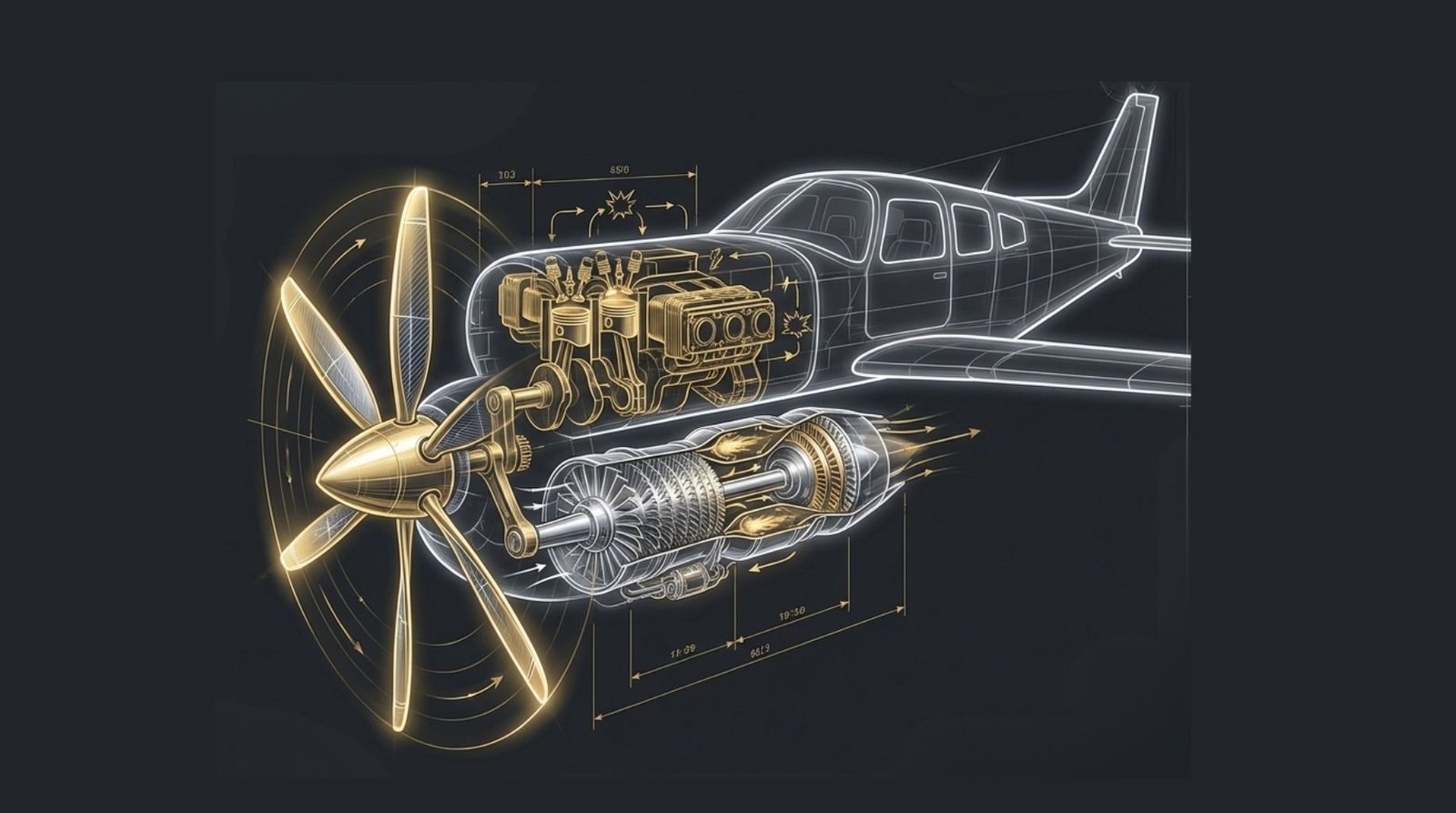
The piston engine, or reciprocating engine, remains the classic workhorse of general aviation. Much like a high-performance car engine, it utilizes cylinders and pistons to convert chemical energy into linear motion, which a crankshaft then translates into the rotational energy needed to spin a propeller.
This process follows the “four-stroke cycle,” remembered by pilots through the mnemonic “Suck, Squeeze, Bang, Blow”:
- Intake (Suck): The piston moves down, creating a vacuum that draws a “cocktail” of air and fuel (typically Avgas 100 or 100LL) into the cylinder.
- Compression (Squeeze): The intake valve closes, and the piston shoots upward, squeezing the mixture into a tiny space to maximize potential energy.
- Power (Bang): At the moment of maximum squeeze, a spark plug ignites the mixture. This controlled burn expands rapidly, shoving the piston down with incredible force.
- Exhaust (Blow): The exhaust valve opens, and the piston moves up one last time to push spent gases out, clearing the chamber for the next cycle.
Common examples like the Cessna 172 Skyhawk and Piper Archer rely on this technology for its simplicity and instantaneous throttle response.
3. The Turboprop: Turbine Power Meets Propeller Efficiency
A turboprop is a gas turbine (jet engine) optimized to drive a propeller through a reduction gearbox. Unlike the intermittent explosions of a piston, a turboprop functions as a continuous flow of power. The internal mechanics are divided into the Cold Section and the Hot Section.
The iconic Pratt & Whitney PT6 utilizes a “reverse flow free turbine” design. Air enters at the rear and moves forward through the core. To understand the “free turbine” concept, imagine a hairdryer blowing onto a windmill: the gas generator (hairdryer) produces high-velocity air that spins a power turbine (windmill), but there is no direct mechanical link between the two shafts.
Internal Flow & Technical Precision:
- Air Intake: Air enters via the inlet duct, often protected by Inertial Separators—vane systems that use centrifugal force to divert debris and ice, making turboprops the ultimate “bush planes” for unpaved runways.
- Compressor: Air passes through axial and centrifugal stages, increasing pressure tenfold.
- Combustion Chamber: In the “Hot Section,” fuel is continuously sprayed and ignited.
- Power Turbine: Hot gases spin the gas generator shaft at a staggering 39,000 RPM (650 rounds per second).
- Reduction Gearbox: Since a propeller would shatter at 39,000 RPM, a gearbox reduces the rotation to a manageable 1,700–2,200 RPM.
- Propeller: The reduction ratio (approx. 15:1) allows the PT6 to drive massive propellers, providing 85% of the aircraft’s thrust.
4. Direct Comparison: Performance and Mechanics
| Category | Piston Engine | Turboprop Engine |
| Fuel Type | Avgas 100 / 100LL (Lead-based) | Jet A1 (Kerosene-based) |
| Optimal Altitude | Low (Below 4 km / 13,000 ft) | Medium/High (4–7 km / 13k–23k ft) |
| Acquisition Cost | ~$1.5M (e.g., Piper M350) | ~$2.2M (e.g., Piper M500) |
| Complexity | Reciprocating; many moving parts | Turbine; continuous rotational flow |
| Weight/Power Ratio | 540 kg for 1,200 hp (WWII Era) | 240 kg for 1,200 hp (Modern PT6) |
| Reliability/TBO | Lower TBO; prone to vibration wear | Extremely high; fewer contacting parts |
| Throttle Response | Instantaneous | Lagged (Inertia of rotating core) |
5. The Concept of Propulsive Efficiency
Niches in aviation are defined by propulsive efficiency: the art of moving a large mass of air slowly versus a small mass of air quickly. Piston and turboprop engines excel at moving large air masses, owning the “low and slow” niche.
However, air density dictates the vertical ceiling. Piston engines struggle above 4 kilometers as the thin air unbalances the fuel-air mixture. Turboprops bridge the gap, using their internal compressors to maintain performance up to 7 kilometers, allowing pilots to fly above the weather and turbulence that trap piston-driven aircraft.
6. The Pilot’s Perspective: Controls and Operations
For flight simulation enthusiasts, moving from a piston to a turboprop requires a shift in how you manage the “Alpha” and “Beta” ranges of power.
| Control Type | Piston Engine (e.g., Cessna 182) | Turboprop Engine (e.g., TBM 930) |
| Thrust/Power | Throttle: Controls Manifold Pressure. | Power Lever: Controls Gas Generator Speed in Alpha range; controls Blade Angle in Beta range. |
| Propeller | Propeller Lever: Adjusts pitch to maintain a constant RPM. | Propeller Lever: Adjusts RPM; includes “Feather” to stop rotation and reduce drag. |
| Fuel/Mixture | Mixture Lever: Manually leans air-to-fuel ratio to prevent engine “choking.” | Condition Lever: Acts as a fuel shutoff valve and selects High or Low Idle. |
Technical Nuance: Modern turboprops often utilize counter-rotation between the gas generator and power turbine. This offsets the immense torque—similar to the frame-bending torque of a “Dom Toretto Dodge Charger”—to prevent the aircraft from potentially flipping over during high power changes like takeoffs.
7. Starting the Fire: A Comparative Startup Sequence
The startup sequence highlights the transition from “spark plugs” to “igniters.”
| Stage | Piston Startup | Turboprop Startup (PT6) |
| Initial Energy | Battery engages electric starter. | Battery/APU engages air turbine starter. |
| Rotation | Crankshaft turns pistons immediately. | Starter spins Gas Generator (NG) only. |
| Ignition Sound | Brief whine followed by engine roar. | The “Infamous Clicking Sound” of igniters. |
| Fuel Intro | Mixture set to rich before/during crank. | Introduced via Condition Lever at 12% NG. |
| Self-Sustain | Occurs after “Bang” stroke cycle. | Occurs at ~50% NG; igniters turn off. |
| Disconnect | Starter Bendix retracts. | Centrifugal Clutch disconnects starter. |
8. Choosing the Right Engine for the Mission
Selecting the right powerplant is a matter of mission profile and “Decision Matrix” logic:
- IF flying short-range, recreational, or primary training routes: Choose Piston. They are more cost-effective ($1.5M vs $2.2M) and offer simpler maintenance for low-altitude hops.
- IF requiring high-altitude weather avoidance or regional airline profitability: Choose Turboprop. The ability to cruise at 25,000 ft provides smoother air and faster block times for commercial operations.
- IF operating out of unpaved, short, or mountain runways: Choose Turboprop. The superior power-to-weight ratio (240kg for 1200hp) provides aggressive climb rates, while the Inertial Separators protect the engine core from gravel and debris.
9. Conclusion: The Future of Mastering Fire
Whether it is the drumbeat of a piston or the sustained roar of a turbine, both engines represent a century of human progress in the mastery of fire. One uses controlled explosions to drive a crankshaft; the other harnesses a high-pressure bonfire to spin a windmill. As we look toward the next leap in propulsion, these mechanical strategies remain the essential tools for conquering the sky, each perfected for its own slice of the atmosphere.