In aviation, the atmosphere is the medium in which we operate. It is never static. As a pilot, you might depart a tropical coast at 30°C and land on a high-altitude plateau where it is 5°C. Because air density dictates every facet of flight—from the lift generated by your wings to the thrust produced by your engines—we require a universal yardstick to make sense of these variables.
This yardstick is the International Standard Atmosphere (ISA), also known as the ICAO Standard Atmosphere. Established by the International Civil Aviation Organization (ICAO Document 7488), this model is the foundation of every performance calculation you make. Ignore it, and your takeoff distance, climb gradients, and fuel burn figures are essentially worthless.
The Necessity of a Global Standard
The aviation industry requires a fixed atmospheric model because real-world weather is too volatile for engineering consistency. Without a standard, a manufacturer could claim a “short takeoff distance” based on a cold day at sea level, while a pilot in the tropics would find those figures impossible to achieve.
The ISA allows us to:
- Normalize Performance: It provides a worldwide benchmark to compare aircraft capabilities regardless of local weather.
- Standardize Data: All Aircraft Flight Manual (AFM) performance tables are built around ISA conditions.
- Calibrate Instruments: Pressure altimeters are calibrated to the ISA model to translate static pressure into a readable altitude.
Core Principles and Physical Assumptions
The ISA is a mathematical model based on the “ideal gas” law. To maintain consistency, the model assumes the atmosphere is:
- Perfectly Dry: Free of all moisture or water vapor.
- Clean: Lacks suspended solid particles like dust, sand, or volcanic ash.
While these conditions never exist in the cockpit, they allow for the precise mathematical lapse rates required for global flight safety and instrument standardization.
ISA Standard Values at Mean Sea Level (MSL)
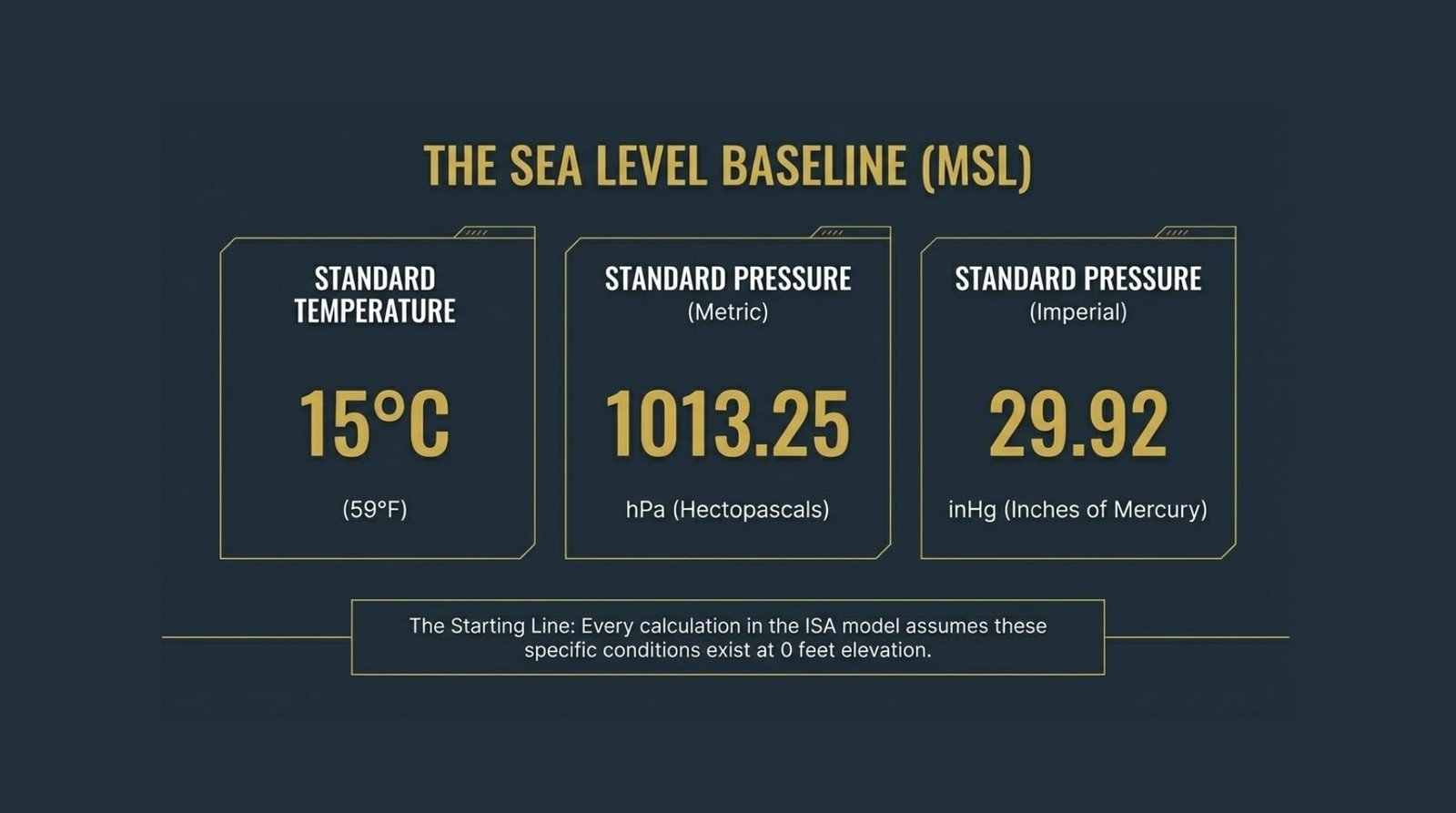
Every calculation begins at Mean Sea Level. These baseline values are the starting point for determining how the atmosphere will behave as you climb.
| Parameter | Standard Value (Metric) | Standard Value (Imperial) |
| Temperature | 15°C | 59°F |
| Pressure | 1013.25 Hectopascals (hPa) | 29.92 Inches of Mercury (inHg) |
| Air Density | 1.225 kg/m³ | 0.002377 slug/ft³ |
Atmospheric Behavior: Pressure and Effective Altitude
In the ISA model, pressure decreases as altitude increases. However, as a professional pilot, you must understand that this reduction is not a perfectly straight line.
- Standard Reduction Rates: In the lower levels, pressure drops at approximately 1 hPa per 30 feet or 1 inHg per 1,000 feet.
- Operational Limit: This rule of thumb is reliable up to approximately 10,000 feet. Above this, the rate of change becomes increasingly variable.
- The “High Altitude” Effect: If you are at an airport where the pressure is lower than standard (e.g., 1000 hPa instead of 1013.25), the aircraft performs as if it were at a higher altitude. We call this a high Pressure Altitude, and it directly penalizes your aircraft’s performance before you even start the engines.
Atmospheric Behavior: Temperature and the Tropopause
The ISA model defines the temperature lapse rate—the rate at which air cools as you climb through the troposphere.
- Standard Lapse Rate: Temperature decreases by 1.98°C per 1,000 feet. For mental math in the cockpit, we round this to 2°C per 1,000 feet.
- The Tropopause: This cooling continues until you reach 36,089 feet. In the real world, the height of the tropopause varies (it is higher at the equator and lower at the poles), but the ISA model fixes it at this specific altitude.
- The Isothermal Layer: From 36,089 feet up to 65,617 feet, the temperature is assumed to remain constant at -56.5°C. Above this point, the model accounts for temperature increases in the stratosphere, though most civilian operations remain below this ceiling.
Calculating Standard Temperature at Altitude
To determine if the air is “Standard,” you must first calculate what the temperature should be at your altitude according to the model.
The Formula (Up to 36,089 feet)
ISA_{temperature} = 15 – (2 \times \frac{Altitude}{1000})
Important Note: This formula is only valid in the troposphere. If your altitude is above 36,089 feet, the standard temperature is directly assumed to be -56.5°C.
Step-by-Step Example: Flight Level 230 (23,000 ft)
- Divide altitude by 1,000: 23,000 / 1,000 = 23
- Apply lapse rate (2°C): 23 \times 2 = 46
- Subtract from MSL standard (15°C): 15 – 46 = -31
- Result: The ISA temperature at 23,000 feet is -31°C.
ISA Deviation: The “So What?” of Performance
“ISA Deviation” is the difference between the actual Outside Air Temperature (OAT) and the theoretical ISA temperature. This is the most critical number for determining your Density Altitude.
- ISA+ (Plus): The air is warmer than standard. Warmer air is less dense, meaning less lift for your wings and less oxygen for your engines. Expect longer takeoff rolls and decreased climb rates.
- ISA- (Minus): The air is colder than standard. Colder air is more dense, providing superior aircraft performance.
Practical Scenario: At a sea-level airport (Standard = 15°C):
- 06:00 AM: OAT is 8°C (ISA -7). The air is dense; the aircraft will perform better than the baseline.
- 01:00 PM: OAT is 25°C (ISA +10). The air is thin. Even though you are at sea level, the aircraft “feels” like it is at a much higher altitude, significantly degrading performance.
Practical Aviation Applications
1. Performance Tables and Interpolation
Most performance tables (Takeoff, Climb, Cruise) are organized by ISA deviation: ISA -20, ISA, and ISA +20. If your calculated deviation is ISA +10, you cannot simply pick a column. You must interpolate between the “ISA” and “ISA +20” columns to find your actual performance figures.
2. Instrument Calibration
Your altimeter does not measure altitude; it measures pressure. It uses the ISA model to tell you how high you are. If the atmosphere is significantly warmer or colder than standard, the “pressure levels” shift, and your altimeter will have an inherent error.
3. Modern Avionics
Glass cockpits often calculate ISA deviation automatically and display it on the Primary Flight Display (PFD) or MFD. While convenient, a senior pilot must always cross-check these values. If the automation fails, your ability to manually calculate ISA deviation is the only thing standing between you and an inaccurate performance plan.
Summary Checklist: ISA Quick Reference
| Parameter | Standard Value |
| MSL Temperature | 15°C (59°F) |
| MSL Pressure | 1013.25 hPa / 29.92 inHg |
| Lapse Rate | 1.98°C (approx. 2°C) per 1,000 ft |
| Tropopause Altitude | 36,089 ft |
| Tropopause Temperature | -56.5°C |
| Isothermal Ceiling | 65,617 ft (Temperature remains -56.5°C) |