
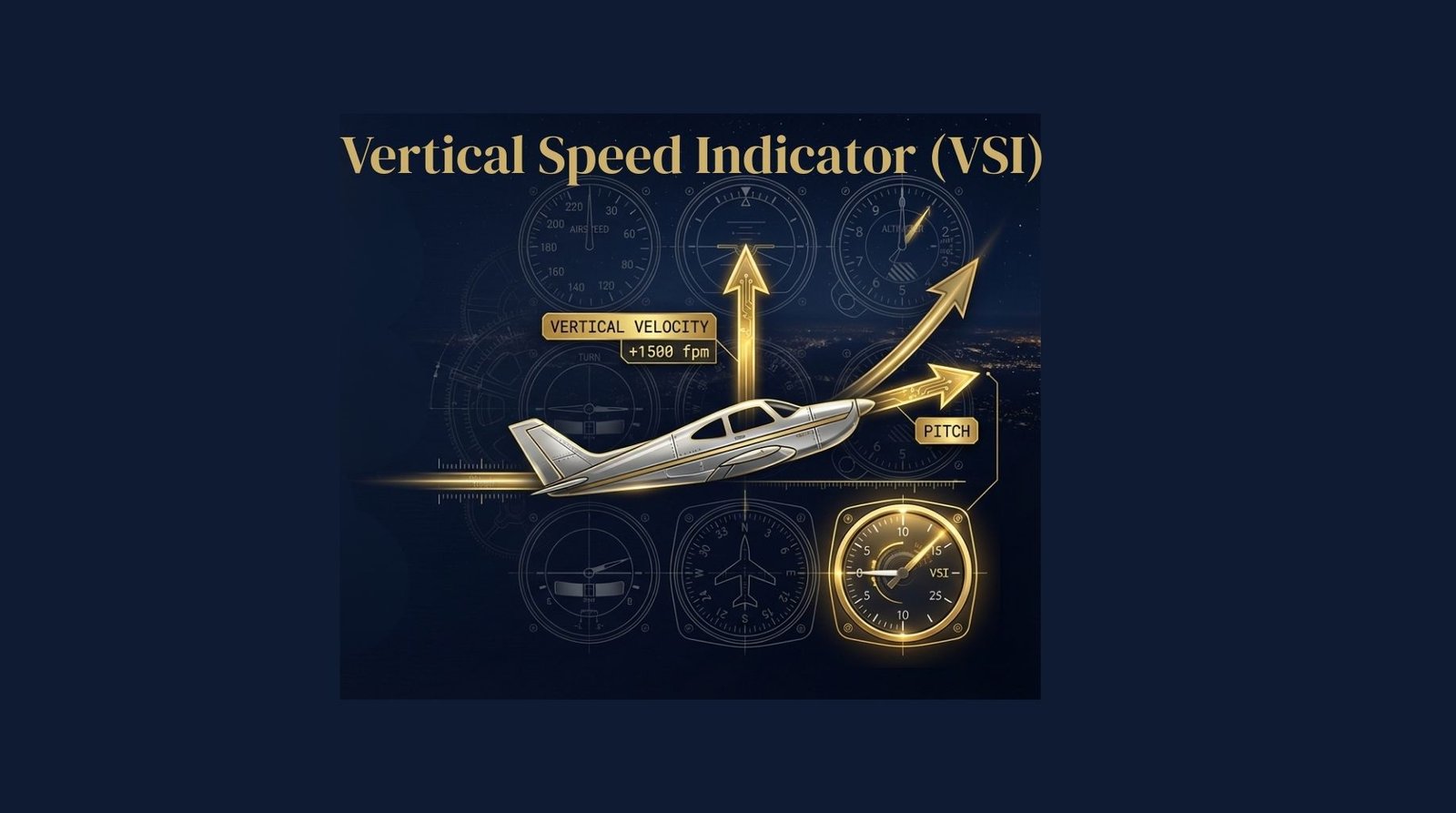
1. Introduction: What is the Vertical Speed Indicator?
In my years of instructing, I’ve found that students often underappreciate the Vertical Speed Indicator (VSI), also known as the “rate of climb and descent indicator” or “variometer.” While the altimeter tells you where you are, the VSI tells you where you are going and how fast you’re getting there.
As one of the “big six” primary flight instruments, the VSI provides a direct readout of your aircraft’s rate of change in feet per minute (fpm). Whether you are holding a precise glideslope on an ILS or verifying a positive rate after takeoff, understanding the mechanics and nuances of this instrument is non-negotiable for professional airmanship.
2. The Anatomy of an Analog VSI
From an avionics perspective, the analog VSI is a masterpiece of simple but effective engineering. It is a differential pressure instrument housed in a sealed case, connected exclusively to the aircraft’s static system.
The Internal Mechanics
- Aneroid/Barometric Capsule (Diaphragm): This elastic metal housing is the heart of the instrument. It receives unrestricted static air directly from the static port.
- The Metering Unit (Calibrated Leak): This is where the “specialist” knowledge comes in. It isn’t just a simple hole. To ensure the VSI remains accurate across varying altitudes and temperatures, the metering unit utilizes a capillary tube and a restrictive orifice. These components work together to compensate for changes in air density, providing a consistent rate indication regardless of whether you’re at sea level or flight level 250.
- Mechanical Linkages: These translate the microscopic expansion or contraction of the capsule into the visible movement of the needle on the instrument face.
The Principle of Differential Pressure The VSI compares “current” pressure with “delayed” pressure. The capsule always reflects the current atmospheric pressure. The case, however, receives that same static air through the metering unit, which restricts the flow. This creates a delay, meaning the case pressure represents what the atmospheric pressure was just a few seconds ago.
Pressure Reactions
| Flight Condition | Capsule Reaction | Pressure Relationship | Needle Deflection |
| Level Flight | Neutral | Case Pressure = Capsule Pressure | Zero |
| Climb | Contracts | Case Pressure > Capsule Pressure | Upward |
| Descent | Expands | Case Pressure < Capsule Pressure | Downward |
3. How the VSI Functions: Trend vs. Rate
In flight training, I teach students to distinguish between the two distinct phases of a VSI reading: Trend and Rate.
- Trend: This is the initial movement of the needle. When you first pull back on the yoke to climb, the capsule pressure drops immediately, but the case pressure remains higher due to the calibrated leak. The needle moves up almost instantly, showing you the direction of the change.
- Rate: Once the climb is established, the calibrated leak allows the case pressure to “catch up” but stay a fixed amount behind the capsule. This stabilized differential provides the actual rate of the climb in fpm.
When you level off, you must anticipate the “lag.” It takes a few seconds for the pressures to equalize through the metering unit before the needle returns to zero.
4. Types of VSI: From Analog to Digital
As cockpits evolve, so does the delivery of vertical speed data.
- Conventional/Analog: Circular dials with a physical needle. These are subject to mechanical wear and traditional lag.
- Digital/Modern: Found on Primary Flight Displays (PFDs), these are usually vertical tapes. An Air Data Computer (ADC) calculates the rate, often augmented by an Inertial Reference Unit (IRU) to provide near-instantaneous feedback by sensing vertical acceleration.
The Instantaneous Vertical Speed Indicator (IVSI) To eliminate the 1-to-9-second lag inherent in analog VSIs, the IVSI incorporates a vertical acceleration pump (dashpot).
- The Action: Inside the dashpot is a piston held in place by springs. When you initiate a climb, inertia causes the piston to move down. This movement creates a suction that immediately decreases the pressure inside the capsule, causing the needle to jump to a climb indication before the static pressure change alone could register.
- Stability: Once the climb is established, the springs return the piston to the neutral position, and the metering unit takes over to maintain the rate indication.
5. Understanding Instrument Limitations and Errors
You must anticipate the four primary errors that can affect your VSI:
- Instrument Error: Minor inaccuracies caused by manufacturing tolerances or mechanical friction in the gears.
- Position/Pressure Error: Inaccuracies caused by the physical location of the static port. Turbulent air or suction around the port during high-speed flight or the takeoff roll can cause the VSI to “wiggle” or show a false rate.
- Maneuver-Induced Error: Sudden changes in pitch, or the deployment of flaps and landing gear, can cause temporary pressure fluctuations at the static port, leading to false indications.
- Lag Error: In standard analog instruments, expect a delay of 1 to 4 seconds (and up to 6–9 seconds in some older or high-rate systems) before the needle accurately reflects the stabilized rate of change.
WARNING: IVSI gotchas While the IVSI is superior for reducing lag, it has a specific “checkride trap.” In a steep turn, the increased load factor (G-load) pulls the dashpot piston down. This creates a suction that causes the instrument to show an artificial climb, even if you are maintaining altitude perfectly. Additionally, in heavy turbulence, the piston will bounce, causing the needle to jump erratically.
6. Emergency Procedures: Static Source Malfunctions
If your static port becomes blocked by ice or insects, the VSI becomes a “frozen” instrument.
- The Indication: The needle will gradually return to zero and stay there, regardless of your actual vertical movement.
- The Solution: Activate your Alternate Static Source.
The Specialist’s Edge: Pressurized Cabin Failures In my experience, many pilots forget a critical scenario: a static line fracture inside a pressurized aircraft. If the line breaks inside the cabin, the VSI is no longer sensing the outside atmosphere. It will sense the cabin altitude. If the cabin altitude is holding steady at 8,000 feet while you are climbing to 30,000 feet, your VSI will show zero. You must be prepared to use your backup instruments and understand that the VSI will only show a rate when the cabin pressure itself is changing.
7. Pilot Pro-Tips: Reading and Calculating
Effective pilots don’t just look at the VSI; they use it to stay ahead of the airplane.
Linear vs. Logarithmic Scaling Pay attention to the face of your instrument. A linear scale shows equal increments (e.g., 500, 1000, 1500). However, many precision VSIs use a logarithmic scale. These expand the markings between 0 and 1,000 fpm, providing much higher sensitivity for small deviations. This is vital for maintaining a precise glideslope during instrument approaches.
Cockpit Rule of Thumb: The 1 in 60 Rule When flying a standard 3-degree glideslope, you need to lose approximately 300 feet per nautical mile (NM). To calculate the required Rate of Descent (ROD) on the fly, use this formula:
Required ROD (fpm) = 5 x Ground Speed (knots)
Example: At a ground speed of 120 knots, you need a 600 fpm descent to stay on a 3-degree path (5 x 120 = 600).
8. Conclusion
The VSI is your primary tool for trend awareness. By understanding the mechanical dance between the capillary tube, the calibrated leak, and the dashpot, you can move beyond simply “reacting” to the needle and start “anticipating” the aircraft’s performance. Treat it as a precision instrument, respect its inherent lag, and always cross-check it against your altimeter for a complete picture of your flight path.