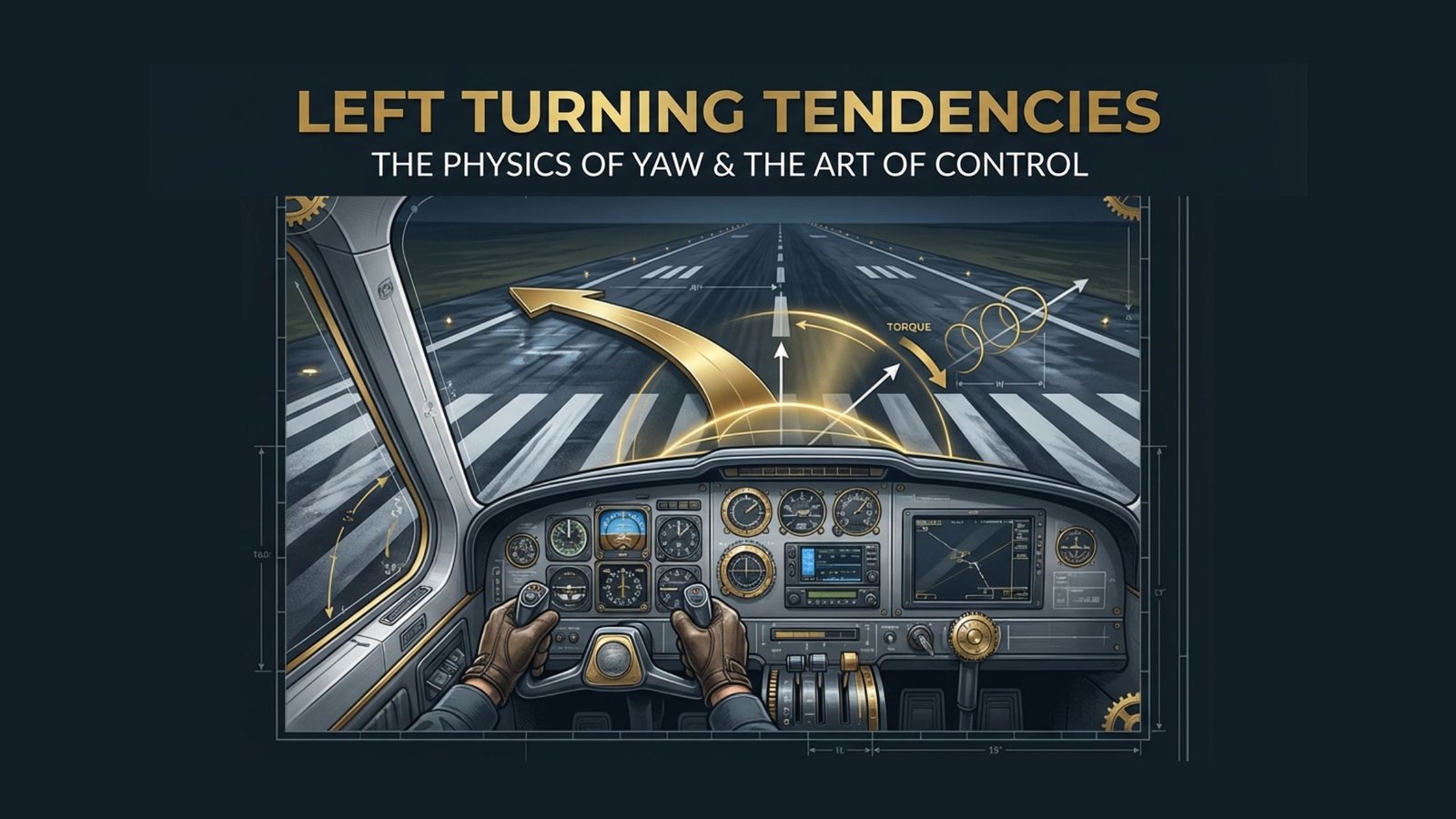
You’re lined up on the centerline, heels on the floor and toes ready. You smooth the throttle forward to the stops, and the engine roars to life. But as the airspeed builds and you begin your takeoff roll, you feel that familiar, invisible hand tugging the nose toward the grass on the left. If you aren’t ready to dance on those rudder pedals, that airplane is going exactly where the physics want it to go—and it isn’t straight down the runway.
This isn’t a mechanical glitch or a crosswind catching you off guard. It is a fundamental reality of flight. Your airplane is subject to four distinct aerodynamic forces known collectively as “Left Turning Tendencies.” To a student, it feels like the plane is possessed. To a veteran, it’s a predictable symphony of chaos that we harmonize with a little bit of “right rudder.” Let’s break down the four forces trying to ruin your perfect departure.
Torque Reaction: The Equal and Opposite Struggle
The first factor is straight out of Newton’s Third Law: for every action, there is an equal and opposite reaction. Think of your engine and propeller as the “action.” From your seat in the cockpit, that prop is spinning clockwise. The “reaction” is the rest of the airframe trying to rotate in the opposite direction—to the left.
Now, listen closely, because this is where students get tripped up: Torque is primarily a rolling tendency. While you’re still on the ground, that left-rolling motion puts more pressure on the left main tire. That extra weight means more friction, which causes the tire to scrub against the pavement and pull the nose left.
Manufacturers try to “build out” this nuisance so you don’t have to work as hard during cruise. In many older birds, the left wing is designed to create slightly more lift at cruising speeds. On newer models, they often offset the engine slightly to use its weight as a counter-balance. But remember, those fixes are rigged for a specific cruise speed. When you’re low and slow with the engine wide open, the physics win every time.
“The more power you put in, the bigger that reaction is going to be.”
P-Factor: The “Bigger Bite” of the Propeller
Technically, we call this “Asymmetric Propeller Loading,” but in the hangar, we just call it the “bigger bite.” To understand P-Factor, you have to realize that your propeller is just a wing that happens to spin.
In straight and level flight, the upward-moving blade and the downward-moving blade have the same angle of attack. But when you pitch that nose up for a climb, you’ve changed the game for that prop.
As the airplane pitches up, the downward-moving blade (which is on the right side of the airplane) suddenly has a much higher angle of attack than the ascending blade on the left. It takes a “bigger bite” of the air, producing significantly more thrust on the right side of the propeller disk. Unlike Torque, P-Factor is a yawing tendency. With more “push” coming from the right side of the nose, the airplane wants to pivot left. This is why you’ll feel the most pressure on your right foot during the initial climb-out when the nose is high and the engine is clawing for altitude.
Spiraling Slipstream: The Corkscrew Attack on the Tail
Imagine the air coming off your propeller not as a straight breeze, but as a spinning, high-velocity corkscrew. This is the “Spiraling Slipstream.” When the prop is spinning fast but the airplane is moving slow, this slipstream wraps itself tightly around the fuselage.
As this air spirals back, it eventually slams into the left side of the vertical fin (the tail). This impact pushes the tail to the right. Because the airplane pivots around its center of gravity, pushing the tail right makes the nose yaw to the left.
However, here is a bit of “expert” synthesis for you: the force of that air hitting the fin also creates a slight right-rolling moment. In a beautiful bit of aerodynamic coincidence, this right roll actually helps offset some of that left-rolling Torque we talked about earlier. As you pick up speed, the “corkscrew” stretches out like a slinky. Eventually, it misses the tail altogether, which is why that left-hand pull starts to relax once you’re cleaned up and moving fast.
Gyroscopic Precession: The 90-Degree Physics Twist
Your spinning propeller isn’t just a wing; it’s a gyroscope. Gyroscopes operate on a principle called “precession.” Essentially, if you apply a force to a spinning disk, the result isn’t felt where you touched it—it’s felt 90 degrees ahead in the direction of rotation.
Think of your prop as a spinning dish. If you push on the top of that dish, the force actually manifests on the right side. This is the hardest concept to visualize, but it’s a major factor for tailwheel pilots. When a “taildragger” starts its takeoff roll, the pilot has to pitch the nose down to get the tail off the ground. That downward pitch is a force applied to the top of the propeller arc. Because of precession, that force is felt on the right side of the propeller, resulting in a sudden, sharp yaw to the left.
“A force applied is felt 90 degrees ahead of the rotation. You don’t have to be a physics major to truly understand this.”
Mastering the Right Rudder
Understanding these four forces—Torque, P-Factor, Spiraling Slipstream, and Gyroscopic Precession—takes the “mystery” out of the cockpit. These forces are a “perfect storm” when you have high power, low airspeed, and a high angle of attack.
The solution is the same one I’ve barked at students for thirty years: “Right rudder!” You aren’t just pushing a pedal; you are counteracting a predictable set of physics to keep the nose pointed at the end of the world.
The next time you feel that pull to the left, will you treat it as a nuisance, or as a perfectly predictable dance of physics between you and your machine? Proper piloting isn’t about fighting the airplane; it’s about knowing exactly what it wants to do before it even tries it.